Our Products
Compressed Air Solutions
  • Screw Air Compressor
  • Oil Free Compressor
  • Diesel Portable Compressor
  • Gas Compressor
  • Specialty Compressor
  • Air Treatment
ISO 9001 Certified
24-Month Warranty
OEM & ODM Support
Factory Direct Price
All products→
What Is a Screw Air Compressor?
Technical Guide

What Is a Screw Air Compressor?

Technical Article
15 min read
Screw Compressor

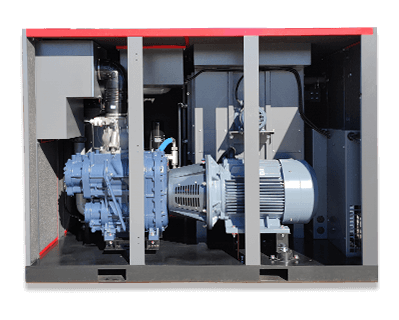
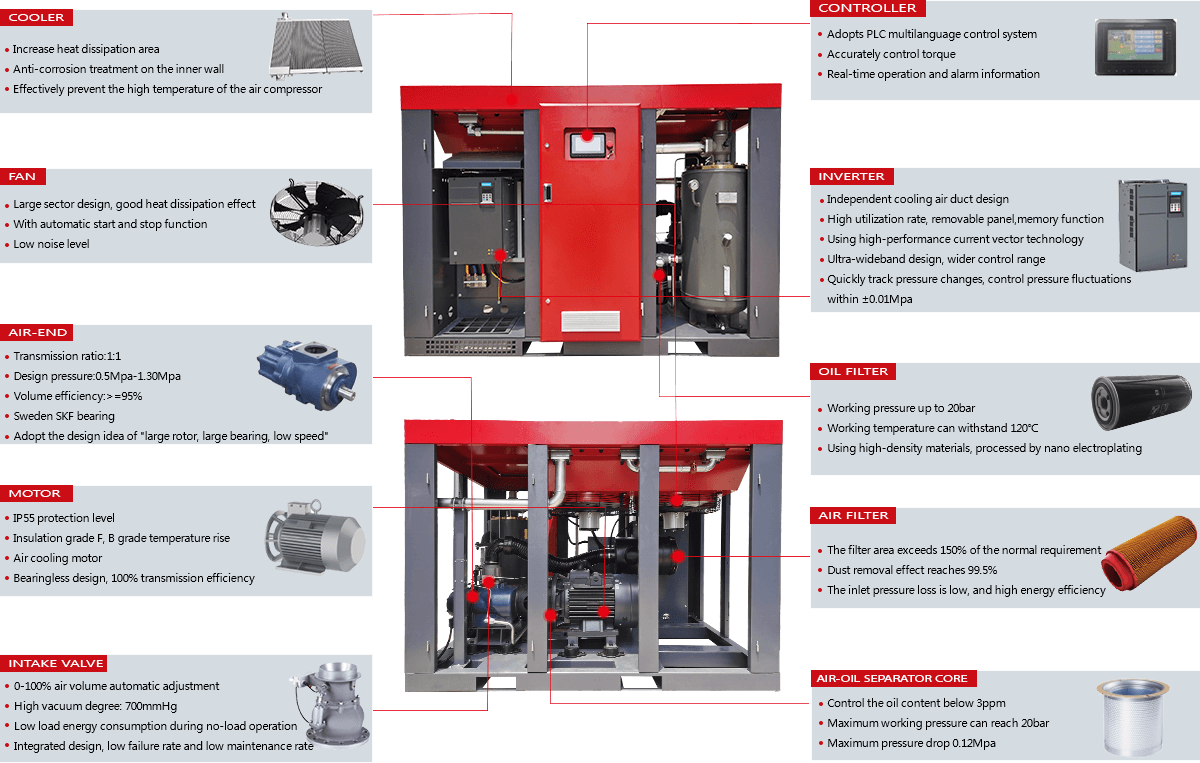
Strip the shell off a screw air compressor, not much inside. An airend, a motor, an oil separator tank, a cooler, a control panel, the rest is pipes and valves. The airend matters most, costs the most too, 30 to 40 percent of the whole machine. Motor is 15 to 20 percent, cooler about 10, controls under 10, the sheet metal shell 5 percent, and the rest is odds and ends of valves and piping.

Two rotors inside the airend.

Manufacturing equipment

Male rotor has four lobes, female has six, 4+6 setup. The male rotor connects to the motor and spins, the female meshes along with it. Air goes in one end, rotors turn, the space between the lobes gets smaller and smaller, air gets squeezed, pressure comes up, out the other end. Oil-injected models spray lubricating oil in there. The oil does three things: plugs up the gaps between rotors so air doesn't leak back, carries away the heat from compression, lubricates the tooth surfaces to cut down wear. The air coming out has oil mist mixed in, needs to go through separation before you can use it.

Rotor material is ductile iron, QT500-7 or QT600-3. QT500-7 is softer, 7% elongation, not prone to brittle fracture. QT600-3 is harder, stronger, only 3% elongation. Surfaces get coated, PTFE or molybdenum disulfide, makes them slippery, so if the two rotors happen to touch they won't seize up. Coating is very thin, tens of microns, wears off after running long enough.

30-40%
Airend Cost Share
0.03mm
Min Rotor Gap
4+6
Rotor Lobe Config

The shape of the rotor teeth is called the profile. SRM profile was developed by the Royal Institute of Technology in Sweden, patent expired years ago, anybody can use it. GHH profile is from the German company GHH. There's also profiles copying the Atlas Copco A-type, some domestic manufacturers use those. Different profiles, efficiency differs by a percent or two, not a big deal. The gap between rotors matters more. Gap too big, air leaks back past the rotors, volumetric efficiency tanks, the machine is spinning and burning power for air that's going nowhere. Gap too small is a problem too, friction, heat, risk of seizure. Domestic airends get clearances down to 0.05 to 0.08 mm. Imported ones can do 0.03 to 0.05 mm. Just those few hundredths of a millimeter, and the price gap is huge.

The airend, OEMs generally don't make it themselves.

There are dedicated airend manufacturers. Atlas Copco is Swedish, GHH is German, VMC is Italian. Domestic ones include Baosi, Hanbell, UnairS, Fusheng. OEMs buy airends from these guys, pair them with a motor, cooler, controller, valves and pipes, stuff it in a shell, slap their own name on it and sell.

Tons of screw compressor brands on the market. Crack them open, the airend is often from the same supplier. Brand A's machine and Brand B's machine, shell is different, color is different, control panel is different, airend is identical. So what are OEMs actually selling? System integration, sales channels, service networks. Not airend manufacturing.

This creates a thing. Same airend, inside different brands, price can differ by 50%. Imports cost more. You're paying for the brand premium, imported components, nationwide service coverage. Tier-one domestics are cheaper, performance is about the same, service in the main industrial areas. Tier-two and three domestics are even cheaper, problem is thin service coverage. Something breaks, hard to find someone to fix it, parts take a while. Waiting a month, it happens.

Airend breaks, basically means replacing the machine. Repair cost is close to buying a new airend, add in teardown and reinstall plus downtime, might as well get a new one. This is why the airend is 30 to 40 percent of the cost. The core is right here. Can't afford it breaking.

Air enters the airend through the intake valve.

Several types of intake valve. Butterfly type is the most common. A butterfly-shaped plate, rotate it, intake opens bigger or smaller, controls how much air comes in. There's also piston type, piston moves back and forth, good seal, used for high-pressure. Rotary valve type, valve core rotates to adjust, needs high machining precision, not used much.

Inside the intake valve there's a rubber diaphragm. This diaphragm is a wear part. Control signal travels by air pressure. Diaphragm senses pressure changes, pushes the valve to move. The diaphragm sits in oil-laden air all the time, bending back and forth, two or three years and it's aged out. Goes hard, elasticity is gone. Valve gets sluggish, doesn't open all the way when it should, intake drops, output drops with it. Machine's been running a few years, feels like not enough air, a lot of people go straight to suspecting the airend, get quotes for overhaul, thousands of dollars. Sometimes it's just the diaphragm. Twenty bucks, ten minutes to swap.

Air comes out after compression, mixed with oil, into the oil separator tank.

Industrial filters

Inside the tank there's a filter element called the oil separator element, fiberglass. Oil-laden air goes through the element, oil mist gets caught, coalesces into droplets that run down the element wall. Clean air goes out the other side. The element clogs over time. How clogged, look at the pressure differential. New element, about 0.2 bar. Keeps climbing as you use it. Hits 0.8 to 1.0 bar, time to change.

Drag it out past that point, the element is basically a wall. Pressure builds behind it, oil has nowhere to go, punches through the weak spots in the fiberglass and rides the compressed air downstream. Downstream there are precision filters, three times the price of a separator element. Those get oil-saturated, have to be tossed. And the piping between separator and point of use, oil residue coats the inside, hard to clean. Factories that push separator elements past their limit trying to save a few hundred end up with contaminated air lines and a pile of dead precision filters.

Compressed air is hot. Needs cooling before you can use it.

Two types, air-cooled and water-cooled. Air-cooled is fans blowing on finned heat exchangers, pushing heat into the air. Fin spacing about 2.5 mm. Tighter than that, dust and fiber from the shop floor pack in between the fins within weeks, airflow chokes off, and the whole cooling stack becomes decoration. 2.5 mm is the compromise that holds up in most factory environments.

Air cooling has a hard ceiling. Ambient goes past 40°C, the temperature differential between the compressed air and surrounding air shrinks so much that heat just sits there. Machine throws a high-temp alarm and shuts down. Air-cooled machines need good ventilation. Stuffy corner of the factory in summer, forget it.

Water-cooled uses circulating water to carry heat away. More efficient than air-cooled, doesn't care about ambient temperature. The headache with water cooling is water quality. Calcium and magnesium in the water deposit on heat exchanger inner walls as scale. Scale conducts heat terribly. One layer and heat exchange efficiency drops a chunk. Over a year, severely scaled heat exchangers lose 10 to 15 percent efficiency. How fast scale builds depends on the water source. Groundwater in limestone regions, hardness 300-400 ppm, scale shows up in months. Municipal supply in soft-water areas, might go a couple years before it's noticeable. Periodic acid washing strips it off. Either use softened water or put in water treatment equipment.

On the control panel there's a controller that runs the whole machine.

Common controller brands, MAM series, Pulite, these are generic, functions are adequate, most domestic machines use them. Atlas Copco has their own Elektronikon, pairs well with their machines, more features.

Two or more machines supplying air together, you need a sequencing system. Sequencing lets the machines take turns, keeps the runtime balanced. Without sequencing, each machine does its own thing. Pressure setpoints differ by just a tiny bit, and one machine becomes the workhorse. Full load every single day, the others sit idle. Workhorse wears out fast, breaks first. With sequencing, the system schedules which starts and which stops based on demand. Everyone takes turns. Overall lifespan longer.

Discharge temperature on the control panel. Pay attention to this number.

75-95°C
Normal Temp Range
10-15°C
Sensor Offset
7-8bar
Standard Pressure

Normal range 75 to 95°C. Drop below 75 and water vapor in the compressed air condenses, mixes with the lube oil, turns it milky white. That's emulsification. Emulsified oil loses its lubricating film strength, metal-on-metal contact goes up, bearing and rotor surfaces start wearing at two, three times the normal rate. Winter startups and light-load running are when this happens most. Some operators in northern China see it every November, drain milky oil out of the sump, top it up, see it go milky again in a week. The fix is usually a thermostatic valve that keeps the oil circuit temperature up, or just running the machine at higher load.

Above 95 is where oil starts oxidizing faster. Forms sludge, clogs oil passages. Run at high temp long-term, oil change intervals get shorter, maintenance costs go up.

Temperature sensor is at the oil separator tank outlet. Temperature here reads 10 to 15°C lower than the airend outlet. When it shows 95°C, the airend outlet is already past 105°C.

The biggest technology shift in screw compressors over the past fifteen years is variable speed drive, VSD.

A fixed-speed machine runs at one speed. Demand drops, it can't slow down. Intake valve closes, motor keeps spinning, airend turns, compressing nothing. Motor still pulls 25 to 30 percent of full-load power. Pure waste. Most factories, air demand fluctuates all day long. Shifts change, machines cycle, weekends run light. A fixed-speed compressor sized for peak sits there unloaded half its life, burning electricity into heat.

VSD slaps a frequency inverter between the grid and the motor. Motor speed tracks demand. Simple concept.

Where it gets interesting is the motor.

Two types in VSD machines. Asynchronous induction motors, the old workhorse, same as what's in fixed-speed units, just inverter-driven now. They work fine at rated speed and down to maybe 60 percent. Below that, trouble starts. An induction motor works on slip, the rotor always turns a bit slower than the magnetic field. At full speed, slip is 2 to 3 percent, no big deal. But slip ratio increases as speed drops. At 40 percent speed, the slip is eating into efficiency badly, the rotor is generating excess heat relative to the shaft work being done, motor efficiency that was 94 percent at full speed can sag to 85, 86 percent. Below 30 percent speed, some manufacturers won't even let the machine go there. The motor is basically turning electricity into warm air at that point.

Permanent magnet motors are a different animal. Neodymium-iron-boron magnets embedded directly in the rotor. No slip. The rotor locks onto the rotating field and follows it exactly. Efficiency stays above 95 percent whether the motor is at full speed or crawling at 30 percent. At 50 percent load, a permanent magnet motor can be 7 to 8 percentage points ahead of an asynchronous one. Over a year on a 37 kW compressor running two shifts, that gap adds up to 15,000 to 20,000 kWh. Real money. Neodymium magnets lose magnetism if they get too hot. The critical temperature is around 150°C for the grades typically used in compressor motors. Normal operation stays well below that. But if the cooling fan fails, or the VFD faults and the motor stalls under load, temperature spikes fast. Once the magnets demagnetize, even partially, the motor loses torque, runs inefficient, and the only fix is pulling the rotor out and remagnetizing or replacing the magnets entirely. That's a factory job, not a field repair. Some operators in southern China have hit this during summer power brownouts, voltage drops, motor overheats, magnets take a hit. The motor still runs afterward, just weaker. They don't even realize it's happened until someone notices the machine can't hold pressure at full demand anymore.

25-40%
VSD Energy Savings
1-2yrs
Payback Period
95%+
PM Motor Efficiency

The cost math on VSD is straightforward once you stop looking at purchase price and start looking at the electricity bill. A 37 kW fixed-speed compressor running two shifts, roughly 5,000 hours a year, at an average 70 percent loading, pulls about 155,000 kWh annually. Same job with a VSD unit, around 105,000 kWh. That's 50,000 kWh saved. At industrial rates in the Yangtze Delta, roughly 0.7 RMB per kWh, that's 35,000 RMB a year in savings. VSD premium on a 37 kW machine is maybe 20,000 to 40,000 RMB depending on brand and motor type. Payback in one to two years. After that, it's free money as long as the machine runs.

Not every factory needs VSD though. Three shifts, steady full load, demand flat as a table, the inverter is just extra complexity for no gain. Fixed-speed is simpler, cheaper, less to break. VSD pays off where demand swings are wide and frequent.

When buying a machine people look at specific power. How much power consumed per unit of air output. Lower number, better efficiency. Problem is this specific power number, different manufacturers don't measure the same way.

Specific power at 7 bar and 8 bar is different. Higher pressure, higher specific power. Full load and partial load specific power are different. Partial load has idle losses baked in. Whether you use FAD (measured free air delivery) or theoretical displacement, numbers come out different. Theoretical displacement doesn't account for losses, looks prettier on paper. Whether power is shaft power or input power, also different. Shaft power is what comes out of the motor shaft. Input power is what the motor pulls from the grid. Difference between them is motor efficiency.

Standards aren't unified, numbers can't be compared. Manufacturer A's specific power is lower, doesn't mean they're really better than B. Might just be measuring differently. To compare specific power, ask each one item by item: what conditions, what load state, how is displacement defined, how is power defined.

Sizing screw compressors for a factory, look at discharge volume and discharge pressure. Volume based on total demand from the air-using equipment, leave some margin, 10 to 20 percent, for load swings. Standard industrial air pressure is 7 to 8 bar.

Imports like Atlas Copco, Ingersoll Rand, Sullair. Expensive, lots of service locations, fast parts. Tier-one domestics Fusheng, Kaishan, Xinlei. Performance is close, cheaper, service in major industrial areas. Tier-two and three domestics cheaper still, service coverage limited, long wait for parts.

Machine breaks down, waiting for parts, one month of downtime, add up the production losses, might be more than whatever you saved on the machine.

Footer Component - SOLLANT
滚动至顶部