Our Products
Compressed Air Solutions
  • Screw Air Compressor
  • Oil Free Compressor
  • Diesel Portable Compressor
  • Gas Compressor
  • Specialty Compressor
  • Air Treatment
ISO 9001 Certified
24-Month Warranty
OEM & ODM Support
Factory Direct Price
All products→
Are Oil-Free Air Compressors Really Oil-Free?
Technical Guide

Are Oil-Free Air Compressors Really Oil-Free?

18 min read
Marine Industry

"Oil-free" refers to the compression chamber. That is all it has ever referred to, and I am going to keep repeating that sentence throughout this article because the number of people who buy these machines without understanding it is staggering.

Oil-free compressor internals

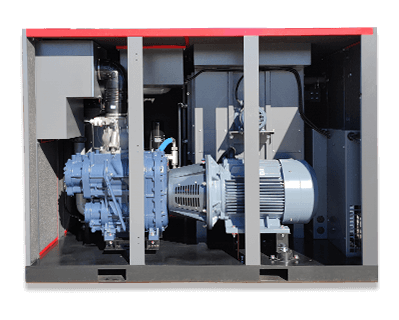
In a dry screw design, two rotors are synchronized by external timing gears and held apart from the housing by tight machined clearances instead of an oil film. In a scroll compressor, the orbiting and fixed scrolls trap pockets of air and compress them with no lubricant present. No oil touches the air during the compression cycle. That is what the manufacturer means when they stamp "oil-free" on the nameplate.

The gearbox driving those rotors needs oil. The bearings need oil. In some machine configurations, oil circulates through cooling jackets wrapped around the compression stage to manage heat. Carbon ring seals, helical-grooved bronze seals, and visco-seals are what keep these oil-wetted zones separated from the compression chamber. When those seals are new and thermal conditions are within design limits, the barrier holds.

Seal replacement intervals on oil-free screw compressors range from 2,000 to 8,000 operating hours. The low end of that range is less than three months of continuous duty. I have spent more time than I would like studying seal failures in these machines, and the mechanism is the same almost every time. Discharge temperatures in dry oil-free machines run 80 to 100°C above inlet temperature because there is no oil mass in the compression chamber absorbing heat the way an oil-injected machine handles it. That thermal load hits the seal material on every compression cycle. The PTFE or carbon material hardens, then cracks. A Parker Hannifin compressed air treatment paper identifies degraded shaft seals and crankcase vapor emissions as contamination pathways in oil-free compressors, and that paper is worth finding because it is one of the few supplier documents that states the problem without hedging.

Once a seal degrades past its threshold, gearbox oil migrates into the compression chamber. The machine keeps running. There is no alarm for this. Oil enters the air stream in small quantities at first, increasing as the seal gets worse. By the time anyone notices, the contamination has been present for weeks or months. Maintenance logs at most sites do not track seal condition between scheduled replacements. The seal is either within its interval or overdue. Nobody is measuring leakage rates in between. I have reviewed maintenance records from maybe fifteen different facilities running oil-free screw machines, and not one of them had any form of seal condition monitoring. The replacement gets done on schedule, or it gets pushed back because the machine is still running and production does not want the downtime, and then you have an oil-free compressor leaking oil into your air system while everyone involved congratulates themselves on the purchasing decision.

The only architecture that removes oil from every subsystem is water-injected compression. Water replaces oil as the bearing lubricant, coolant, and sealing medium. Atlas Copco's AQ series uses stainless steel internals and a closed-loop water treatment circuit to achieve this. The corrosion management on these machines is a full-time concern. Water and precision machinery at elevated temperatures corrode things. That is the tradeoff, and I think it is a reasonable one for certain applications, but it is a tradeoff.

Intake Air

Compressor rooms sit near loading docks, machine shops, paint booths, parking structures. The ambient air feeding the compressor intake carries hydrocarbon vapor from vehicle exhaust, metalworking fluid mist, solvent fumes, volatile organic compounds from coatings. A panel filter on the intake catches dust. It does nothing about vapor-phase hydrocarbons.

0.14 mg/m³
Semi-Rural Ambient
0.67 mg/m³
Urban Roadside
0.01 mg/m³
ISO Class 1 Limit

UK DEFRA monitoring data that Parker Hannifin compiled in a white paper showed ambient hydrocarbon concentrations at 29 sampling points across different environments. Semi-rural locations: 0.14 mg/m³. Roadside urban monitors: 0.67 mg/m³. Industrial zones: 0.05 to 0.5 mg/m³. These are the conditions that exist where compressors operate.

At 7 bar gauge, a compressor works at roughly 8:1 absolute pressure ratio. Inlet air at 0.1 mg/m³ comes out at 0.8 mg/m³. ISO 8573-1 Class 1 allows 0.01 mg/m³ total oil.

So even a perfectly functioning oil-free compressor contributing zero contamination from its own internals will exceed Class 1 by a factor of 80 based on what it pulled in from outside. The compressor has no way to remove vapor-phase hydrocarbons from the air it compresses. Downstream filtration for liquid oil, aerosols, and vapor is required regardless of compressor type.

I realize I am belaboring this but it keeps being the part that procurement departments miss. They buy an oil-free compressor and assume the air coming out is oil-free. It is not. It cannot be. The thermodynamics of pressure-ratio amplification make it impossible without post-compression treatment.

Class 0

I am going to keep this section shorter than the topic probably deserves because the ISO standards discussion tends to swallow articles whole and I think the mechanical and economic issues above matter more for people making purchasing decisions.

Compressed air filtration system

Class 0 carries no fixed numerical limit. The buyer and seller are supposed to negotiate a specific contamination ceiling tighter than Class 1's 0.01 mg/m³ and document it. Without that documented number, the specification means nothing. Blackhawk Equipment made this point in a 2025 analysis. Quincy Compressor, which manufactures oil-free machines, has said publicly that many manufacturers claim Class 0 incorrectly and that there is a pattern of discrepancy between lab results and field results because manufacturers test in controlled environments with minimal ambient contamination.

The 1991 edition of the standard topped out at Class 1, which at 0.01 mg/m³ happened to match what premium coalescing and activated carbon filtration could deliver. Atlas Copco's compressed air blog described the original standard as having been "made by and made for" filter manufacturers. Class 0 was added in 2001. The 2010 revision tightened measurement methodology. Two test methods exist for the aerosol and liquid portion: B2, a partial-flow method sampling the center of the air stream, and B1, a full-flow method capturing the entire pipe cross-section. Most manufacturers certify against B2. Atlas Copco tested the Z-series under B1 with zero detectable oil, but their test facility's ambient hydrocarbon concentration was 0.003 mg/m³. Industrial facilities typically see concentrations 20 to 100 times higher. The same Parker Hannifin data I cited earlier makes that obvious.

Specification writers keep putting "Class 0" on procurement documents without filling in the number. The sales engineer is not going to volunteer that the specification is incomplete because ambiguity favors the seller.

Rotor Coatings

PTFE blended with graphite powder, double-layer application. The graphite reduces friction, and the layered approach allows the coating to compress and conform during the first several hundred hours of operation, tightening rotor-to-housing clearance beyond what machining alone achieves. Atlas Copco holds tolerances on the Z compressor elements that they describe in terms of fractions of a human hair. For high-temperature service, some designs substitute MoS₂, which handles higher thermal loads but fails in humid conditions. If you are installing in a coastal area or a tropical climate or any facility without climate-controlled compressor rooms, MoS₂ is the wrong choice.

Two-stage designs split the pressure ratio to roughly 3.5:1 per stage, reducing discharge temperatures. Both stages still run much hotter than oil-injected equivalents.

PTFE degrades near 200°C. A single-stage dry oil-free screw element's discharge temperature sits at 160 to 180°C under normal load. In hot climates where intake air reaches 40°C, the margin between operating temperature and degradation temperature shrinks to nearly nothing. I talked to an operator at a facility in the Gulf region running a single-stage oil-free machine where the thermal margin at peak ambient conditions was calculated at under 10°C. They had been running that way for two years without issue, which they took as proof that it was fine. It might have been fine. It might also have been consuming its coating at an accelerated rate with no indication on the control panel that anything was wrong.

That is the specific problem with coating degradation: there is no external indication. Moisture gets into micro-cracks in thinning PTFE. Spot corrosion develops on the steel substrate. A corroded patch roughens the surface. Local friction goes up. Temperature goes up locally. The coating thins faster there. More moisture enters. The loop accelerates. Meanwhile, internal leakage across the rotors increases over weeks and months. The machine draws more power to deliver the same volume. Discharge pressure drifts down. But the compressor keeps running and the control panel shows nothing because there is no fault code for coating degradation. If you are tracking specific power in kW per cubic meter per minute, you will see the trend. Most facilities do not track specific power. They track runtime hours and fault codes.

70%
Replacement vs. Purchase Cost
$126K
Airend Bill (200 kW Unit)
50K hrs
First Replacement Window

When the coating is gone, the airend gets replaced. Atlas Copco's documentation says the rotor coating cannot be repaired on-site and recommends a new OEM element. FS-Elliott's published cost guidance puts replacement cost at up to 70% of the original machine price. A 200 kW unit purchased at $180,000 faces a $126,000 airend bill. That bill shows up within the first 50,000 operating hours. Nobody at the capital approval meeting heard that number because the sales process is structured around initial cost. The five-year maintenance budget did not include it. The seven-year total cost of ownership analysis was not performed because nobody asked for one.

Compressor maintenance

Third-party refurbishment exists. Atlas Copco has published teardown analyses of non-OEM refurbished elements and found reused wear components, single-layer Teflon without graphite, tolerances that did not meet original specifications. Atlas Copco estimates that non-OEM airend savings get erased within about 13 months by increased energy consumption. I think that estimate is probably directionally correct and probably inflated in magnitude, which is what you would expect from the company selling the $126,000 alternative. Some third-party rebuilds are poor quality. Some are adequate. The procurement team does not have a way to evaluate which is which because the coating specs are proprietary, the rotor profiles are proprietary, and the inspection criteria are proprietary. That is lock-in. Whether it exists because the engineering is genuinely that specialized or because the OEM structured it that way to protect parts revenue is a question I cannot answer from outside. Probably both, in proportions that vary by manufacturer.

Oil-Injected Plus Filtration

The oil-injected side of the industry has a counterargument. Pair a good oil-flooded rotary screw with multi-stage coalescing filtration and activated carbon adsorption, and the air quality can meet Class 1 for oil content. The compressor costs less, sometimes half the price of an equivalent oil-free installation. When the filtration train is working correctly, purity is measurable.

The problem is keeping the filtration train working correctly over years.

I want to focus on activated carbon because I think it is the weakest link in the oil-injected-plus-filtration approach and it does not get enough scrutiny.

Published filter manufacturer data rates carbon bed life at roughly 41 days at 20°C. At 38°C, the same bed lasts about 4 days. That is not a gradual decline. The adsorption capacity collapses with temperature.

Compressed air exits the aftercooler at 10 to 15°C above ambient. In summer, across most industrialized regions, the air reaching the carbon filter is well above the temperatures used to generate the catalog service life. When the carbon saturates, oil vapor passes through. There is no alarm. There is no visual indicator. The gauges read normal. You find out when someone tests the air downstream or when a product batch fails.

Coalescing filters degrade with particulate loading and can rupture under excessive differential pressure, releasing accumulated oil in a burst.

Condensate disposal on oil-injected systems requires either an oil-water separator or contracted hazardous waste removal. FS-Elliott's total-cost-of-ownership analysis puts annual condensate treatment at up to $50,000 for larger installations. Oil-free condensate typically goes to sewer without treatment.

I should note that the Parker Hannifin paper I keep referencing discusses filtration system limitations in some detail and is worth reading for anyone evaluating the oil-injected-plus-filtration approach. Their position is obviously not neutral since they sell filtration equipment, but the technical content on adsorption capacity and temperature is consistent with what other filter manufacturers publish.

Two Cases

Food production facility

A frozen dough manufacturer in southern France was producing for European supermarket chains and using compressed air in direct contact with packaging materials. Customers reported off-odors from the bags. Third-party testing traced it to oil in the compressed air. The batch was pulled. The supplier's standing with retail accounts took damage that outlasted the incident. Minnuo Compressor published this case in a 2025 application study.

A CDMO outside Bangkok ran an oil-injected compressor with five-stage downstream filtration designed to meet WHO GMP and EU GMP. Compressed air sampling in the packaging area came back above 0.005 mg/m³ for oil. Auditors flagged it. Filter and carbon replacement was running over $25,000 per year, and air quality was still inconsistent between sampling events. They switched to water-lubricated oil-free compression. Maintenance costs dropped by $18,000 annually.

In both cases the compressor was running and the filters were in place. The contamination built up over months through gradual drift: seal capacity declining incrementally, carbon loading faster than the replacement schedule accounted for. The frozen dough manufacturer is the more interesting case to me because it illustrates how contamination can travel through packaging materials and be detected organoleptically by consumers before it shows up in the plant's own quality testing. The off-odor complaint came from supermarket customers, not from the manufacturer's QC lab.

Piping

An oil-free machine installed on piping that previously served an oil-injected system will produce contaminated air for months. Pipe walls carry residual oil film from years of prior service. That film releases into the air stream as pressure pulsations and flow velocity changes disturb it. A European pharmaceutical plant cited in a BCAS Code of Practice guidance note found that contamination at the point of use stayed above Class 1 for over four months after installing an oil-free compressor on legacy carbon steel piping.

Rubber and nylon distribution hoses release hydrocarbon particulates. Shared headers between oil-injected and oil-free compressors allow cross-contamination through the distribution network.

I keep seeing projects where the team spent months evaluating compressor technology, selected the right machine, installed it on twenty-year-old carbon steel pipe, and then could not understand why the point-of-use air quality did not match the compressor specification sheet. Changing the compressor without changing the piping changes the nameplate in the compressor room. The air quality at the point of use depends on every component between the compressor discharge and the application, and the piping is usually the oldest and least documented part of that system.

The BCAS guidance note I mentioned is one of the few industry documents that addresses piping contamination specifically, and it recommends either replacing legacy piping or performing extended flushing and testing before commissioning an oil-free compressor on existing lines. Most project budgets do not include pipe replacement because the compressor vendor's scope of supply ends at the compressor discharge flange.

Specification

No compression technology produces air meeting Class 1 for oil without downstream treatment. An oil-free compressor removes the machine as a contamination source. It does not remove the atmosphere or the piping.

For direct-contact applications in pharmaceutical manufacturing, food production, semiconductor fabrication, and medical gas production, oil-free compression eliminates the largest single controllable contamination variable. Post-compression treatment is still required.

For general industrial service where trace oil is tolerable, oil-injected compression with maintained filtration costs less and works. Maintained is doing a lot of work in that sentence. Activated carbon service life must be calculated from measured temperatures at the carbon filter inlet. Not from the catalog. Not from the data sheet. From a thermocouple on the pipe at the filter inlet, read during the hottest part of the hottest month. If the carbon bed replacement schedule is based on catalog conditions at 20°C and the filter inlet sees 35°C in August, the bed is going to saturate weeks before the scheduled change. Nobody will know until the air downstream is tested or until a product batch fails.

The compressed air industry has spent forty years letting "oil-free compressor" substitute for "oil-free air." Equipment manufacturers benefit from the ambiguity. Procurement teams perpetuate it by writing specifications around compressor type instead of point-of-use air quality. By the time contamination shows up in a failed audit or a customer complaint, the purchasing decision is years old and the people who made it have moved on or forgotten the details.

Footer Component - SOLLANT
滚动至顶部