Our Products
Compressed Air Solutions
  • Screw Air Compressor
  • Oil Free Compressor
  • Diesel Portable Compressor
  • Gas Compressor
  • Specialty Compressor
  • Air Treatment
ISO 9001 Certified
24-Month Warranty
OEM & ODM Support
Factory Direct Price
All products→
Two Most Important Compressor Specs: CFM vs PSI
Technical Guide

Two Most Important Compressor Specs: CFM vs PSI

Technical Article
14 min read
Packaging

PSI is pounds per square inch. Pressure. CFM is cubic feet per minute. Airflow volume over time. Every compressor gets sold on both numbers, and a dozen other numbers besides, and the dirty truth of the whole business is that PSI is the one everybody looks at and CFM is the one that decides whether the comp actually runs the tools.

That statement deserves the rest of this article to support it.

The Curve


CFM and PSI on a compressor are not two independent ratings. They cannot be. The pump displaces a fixed geometric volume per revolution. Compressing that fixed volume to a higher final pressure takes more work per stroke, and the motor only has so much torque to give. More of the torque budget goes to pressure, less goes to cycling speed, less air moves per minute. CFM drops as PSI rises. This is the pump's performance curve, and every positive-displacement compressor on earth has one.

The spec sheet gives one point on that curve. "5.0 CFM @ 90 PSI." That is not the compressor's CFM. That is the compressor's CFM at 90 PSI. At 40 PSI the same machine moves more air. At 130 PSI, less.

The mechanism behind the curve has a specific name in compressor engineering: clearance volume re-expansion. At the top of the compression stroke, the piston cannot touch the valve plate. There is a gap, the clearance volume, set by the head gasket thickness and the piston deck height. This gap traps a small pocket of compressed air at discharge pressure after the exhaust valve closes. On the next intake stroke, this trapped pocket has to re-expand back down to atmospheric pressure before the intake valve can open and fresh air can enter the cylinder. The higher the discharge pressure, the more volume this re-expansion occupies, and the less room is left for fresh intake air.

~8%
Re-expansion loss at 93 PSIG
~15%
Re-expansion loss at 130 PSIG
~22%
Re-expansion loss at 175 PSIG

The math on this is not complicated but it is ruthless. A pump with 4% clearance volume ratio running at a compression ratio of 7.3:1 (which corresponds to about 93 PSIG discharge at sea level) loses roughly 8% of its intake displacement to re-expansion. Push the same pump to 130 PSIG, a compression ratio of about 9.8:1, and the re-expansion loss climbs to 15%. At 175 PSIG, compression ratio 12.9:1, the loss hits 22%. These numbers come from the standard clearance volume equation (volumetric efficiency = 1 - c[(P2/P1)^(1/k) - 1], where c is the clearance ratio and k is the specific heat ratio for air, 1.4). The equation is in every compressor engineering textbook and it does not negotiate.

This is the mechanical reason two-stage compressors exist. Split the compression across two cylinders with an intercooler between them, and each stage works at a lower compression ratio. Lower ratio per stage means less re-expansion per stage. A two-stage pump can deliver air at 175 PSIG with a combined volumetric efficiency that a single-stage pump already starts losing at 120 PSIG. The intercooler between stages is not a vague "efficiency" device. Its job is specific: remove the heat of first-stage compression so the second-stage cylinder receives cooler, denser air. Denser intake charge means more air mass per stroke at the final discharge pressure. More mass per stroke is more CFM at high PSI. That is the whole justification for the added cost and complexity of a two-stage pump head, and it is entirely about defending CFM at elevated PSI.

Compare two compressors by their CFM ratings only if both ratings are at the same PSI. A unit rated at 7 CFM @ 40 PSI might deliver less usable air at working pressure than a unit rated at 5 CFM @ 90 PSI. The 40-PSI number looks bigger on the shelf tag. That is the point.


PSI Does Not Gate Most Tool Selection


Framing nailer: 80 to 120 PSI. Impact wrench: 90 PSI. HVLP spray gun: 28 to 50 PSI at the cap. DA sander: 90 PSI. Die grinder: 90 PSI. Blasting cabinet: 80 to 100 PSI.

Every single-stage piston compressor on the retail market hits at least 125 PSIG. Most hit 150. Two-stage units reach 175 and above. Finding a compressor that cannot meet the PSI requirement of a common pneumatic tool requires deliberate effort.

Brad nailer0.3 CFM
Framing nailer (full production)2.2 CFM
DA sander (continuous)11 CFM
1-inch impact wrench10 CFM
Blasting cabinet (3/16 nozzle)20 CFM
Dental handpiece0.5 CFM

CFM is where tools separate from each other. A brad nailer: 0.3 CFM per shot. A framing nailer: 2.2 CFM at full production pace. A DA sander: 11 CFM continuous. A 1-inch impact: 10 CFM. A blasting cabinet with a 3/16 nozzle: 20 CFM. A dental handpiece: 0.5 CFM. The CFM spread across common air tools is enormous. PSI barely varies between them. CFM is the spec that separates a compressor that works from one that runs nonstop, loses tank pressure, bogs the tool, overheats, and wears itself out.

And CFM demand is additive. Two tools running simultaneously need the sum of their CFM, not the CFM of the hungrier one. This gets overlooked all the time.


The CFM Number on the Box


No mandatory standard governs how consumer compressor CFM must be measured and disclosed. This creates an information asymmetry that the industry does not rush to fix.

Delivered CFM at 90 PSI is the useful measurement. Displacement CFM is the theoretical swept volume assuming perfect filling, perfect sealing, zero re-expansion, zero valve restriction. Displacement CFM exceeds delivered CFM by 25 to 40% on the same pump. Both appear on packaging. Both say "CFM."

A few manufacturers test at 0 PSIG discharge. No back-pressure means no re-expansion loss, no pressure-differential valve restriction, maximum volumetric efficiency. The number is huge and useless for predicting performance against a pressurized tank.

CAGI (Compressed Air and Gas Institute) runs a verified data sheet program with independent testing at standardized conditions. Manufacturers who participate have their delivered CFM numbers audited. Absence from CAGI is not an accusation. It is a data point.

Compressor pump internals
Valve plates and cylinder assemblies define real-world CFM delivery

Valve Timing, Pump RPM, and Why This Is Where the Money Is


This section matters more than everything else in this article combined, and it is the section that has no equivalent in any consumer buying guide, because publishing this information would destroy the pricing structure of the consumer compressor market.

A piston compressor breathes through valves. Reed valves on most reciprocating designs: thin strips of spring steel or stainless, sometimes Swedish valve steel (Sandvik 7C27Mo2 or equivalent), clamped at one end, free to deflect at the other. On the intake stroke, cylinder pressure drops below atmospheric, the differential lifts the intake reed off its seat, air enters. On the compression stroke, cylinder pressure rises above discharge line pressure, the differential lifts the exhaust reed, compressed air exits.

Each valve event has a physical response time governed by the reed's mass, stiffness, and preload. The reed does not open the instant differential pressure appears. It accelerates from its seat, reaches full lift at some point during the stroke, then decelerates and re-seats after the differential reverses. This entire open-travel-close sequence occupies a finite number of crankshaft degrees.

At low pump RPM, each stroke takes a long time relative to the valve response. The intake valve opens early in the downstroke, reaches full lift well before the piston reaches bottom dead center, and the cylinder fills to near atmospheric pressure. Volumetric efficiency is high. At high RPM, the piston moves faster than the valve can follow. The intake reed may not reach full lift before the piston is already 40% through the intake stroke. The cylinder never fills completely. On the exhaust side, the reed may not fully re-seat before the piston reverses for the next intake, allowing a backflow pulse of high-pressure air into the cylinder that further displaces fresh charge.

This gets worse in a specific way that matters for compressor selection. The volumetric efficiency loss from valve timing is not proportional to RPM. It accelerates.

A pump running at 700 RPM on a belt drive might hit 89% volumetric efficiency. The same pump head direct-coupled to a motor at 1750 RPM might manage 74%. At 3450 RPM, the same head would struggle to reach 60%. The reed valve physically cannot cycle fast enough. It starts fluttering, bouncing off the seat rather than seating cleanly, and each flutter event lets compressed gas leak backward.

700 RPM
~89% Vol. Efficiency
1750 RPM
~74% Vol. Efficiency
3450 RPM
~60% Vol. Efficiency

Industrial pump heads are designed around this. Quincy's QR-series, Ingersoll Rand Type 30, Saylor-Beall, Champion R-series, Kellogg-American. These pumps have big bores, long strokes, heavy valve plates with lapped sealing surfaces, and they turn at 600 to 1000 RPM on belt-drive setups. The valve geometry, reed thickness, and preload are tuned for that RPM band. At 750 RPM on a Quincy QR-25, the intake reed has approximately 40 milliseconds to complete its full open-close cycle. At 3450 RPM on a direct-drive consumer pump, that window shrinks to about 8.7 milliseconds. Same physics. Less than a quarter of the time.

The reed material matters here in a way that connects directly to long-term CFM retention. High-quality valve reeds made from tempered Swedish steel (or the Sandvik strip steel grades purpose-made for compressor valves) maintain their spring rate through millions of cycles. They seat flat, seal well, and the pump holds its delivered CFM rating with minimal degradation over thousands of hours. Cheap stamped reeds from generic carbon steel lose temper faster, develop micro-fatigue cracks at the root, start fluttering at progressively lower RPMs as they weaken, and the pump's CFM drifts down without any single obvious failure event. A compressor with cheap valves at 600 hours does not sound broken. It sounds the same. It just delivers less air than it used to, and the owner chases the problem through the regulator, the hose, the fittings, and the tool before anyone thinks to pull the valve plate.

This is why pump RPM is arguably the most informative single spec for predicting real-world CFM performance and longevity, and it is the spec that almost never appears on consumer packaging. Publishing pump RPM would let a shopper directly compare a $350 direct-drive unit spinning at 3450 RPM against an $800 belt-drive unit turning at 750 RPM, and the comparison would make it obvious why one costs more. The valve timing explanation above would be inescapable. The industry prefers to compete on HP and max PSI, both of which obscure pump quality rather than revealing it.

The weight proxy works when RPM is unavailable. Two compressors claiming similar CFM, where one weighs 85 lbs and the other weighs 62 lbs, are not comparable machines regardless of what the labels say. The weight difference is cast iron versus aluminum cylinders, machined valve plates versus stamped, pressed and ground bearings versus open cages, a balanced crankshaft versus a rough forging. Heavy pumps dissipate heat better (cast iron conducts and stores thermal energy more effectively than aluminum in this application because the wall sections are thicker and the total thermal mass is greater). Heavy pumps hold bore tolerances longer. Heavy pumps maintain ring seal longer. The weight is the quality.


Belt Drive


The pulley ratio drops a 3450 RPM motor to 700 to 1100 RPM at the pump crank. Everything above about valve timing at low RPM applies. The belt also absorbs momentary overloads through slip rather than transmitting torque spikes into the crank bearings. The flywheel stores rotational energy to smooth the pulsed torque of reciprocating compression. The physical gap between motor and pump allows cooling airflow around both.

Direct-drive: lighter, cheaper, more compact, fine for brad nailers and tire chucks. The pump spins at motor speed and lives in the volumetric efficiency penalty zone described above. Rebuild shops see direct-drive pump heads come in for ring jobs and valve replacements at roughly a third to a fifth of the service hours that belt-drive heads accumulate before needing the same work.

Belt drive compressor system
Belt-drive configurations lower pump RPM for improved volumetric efficiency and longevity

HP


Horsepower measures motor input power. A 3 HP motor on a pump with good volumetric efficiency delivers more CFM than a 5 HP motor on a pump with bad efficiency. HP tells you what the motor draws from the wall. CFM at rated PSI tells you what the pump delivers into the airline. These are connected by the pump's mechanical efficiency, which varies enormously across designs. HP gets the big font on the box because it maps onto intuitions from cars and lawn mowers. Those intuitions are wrong in this context.


Tank Size


Intermittent tools (nailers, blow nozzles, tire filling): bigger tank means more shots between pump cycles and fewer motor starts per hour. Motor start inrush current stresses the start windings and the pressure switch contacts, so fewer starts per hour extends motor life. For intermittent use, tank size is a valid spec.

Continuous tools (sanders, grinders, blasting): bigger tank delays the inevitable pressure drop by maybe a minute. The tool still bogs out once the tank depletes to cut-in pressure. Tank volume does not manufacture CFM. The pump makes CFM. The tank stores a finite amount of it.


Delivery Plumbing


The standard 1/4-inch industrial interchange coupler (the one in the box with every consumer comp) chokes flow above 5 CFM. A 3/8-inch body coupler opens roughly double the cross-section. A 25-foot, 1/4-inch ID hose at 10 CFM and 90 PSI loses 12 to 15 PSI to wall friction. Same flow through 3/8-inch ID: 3 PSI loss. Each PSI burned in the plumbing is pressure the comp has to make up, which pushes the pump higher on its inverse curve and reduces available CFM at the tank.

12–15 PSI
Loss through 1/4″ ID hose
3 PSI
Loss through 3/8″ ID hose
20–25 PSI
Typical total plumbing loss

A shop setup with 1/4-inch coupler, 1/4-inch hose, two street elbows, and an FRL can eat 20 to 25 PSI between tank and tool. A comp cutting out at 115 PSIG delivers 90 to 95 at the tool. The spec sheet CFM was rated at the pump head, not at the end of 30 feet of undersized plumbing through three restrictions.

People who run air tools for a living start from the tool CFM requirement at the tool inlet and work backward through the plumbing to the tank. Starting from the comp and hoping the air makes it to the tool is how shops end up short.


Oil-Lubed Versus Oil-Free


Oil-free is a process requirement for paint, medical air, food packaging, dental, and clean-room environments. For those applications it is not optional.

For general shop air, oil-lubed piston pumps hold their CFM rating over time because the oil film maintains ring seal, transfers heat from the cylinder bore to the cooling fins, and keeps blowby low as the rings wear in rather than wear out. Oil-free pumps use Teflon or PTFE ring coatings that wear faster than steel-on-iron running in oil. Blowby increases measurably over a few hundred hours. A new oil-free pump delivering 5.0 CFM at 90 PSI might deliver 4.1 at the same pressure at 800 hours. An oil-lubed pump of similar build quality at 800 hours with proper oil changes: still north of 4.8 CFM.

500–2,000 hrs
Oil-free pump head life
5,000–15,000 hrs
Oil-lubed pump head life

Oil-free piston pump head life: 500 to 2000 hours. Oil-lubed: 5,000 to 15,000. The ring and valve condition at end of life tells the story. Oil-free heads come apart with scored bores and crumbled ring material. Oil-lubed heads come apart with intact bores and rings that still have measurable tension.


OEM Supply Chain and the Spec Sheet Gap


A large fraction of consumer comps sold under North American and European labels are manufactured in Zhejiang and Guangdong province OEM plants. These plants produce across a wide quality range. The same factory makes cast-iron cylinder heads with lapped valve seats and precision-honed bores for one buyer, and aluminum heads with stamped valves and production-tolerance bores for another buyer at lower cost per unit.

Both share the same bore and stroke on the engineering drawing. Both claim the same displacement. The divergence is inside: ring compound, valve steel grade, bearing type, bore finish, crankshaft balance quality. A brand importer specs to the cost tier that lets the CFM number survive testing on the pre-production sample. The production run, optimized for margin, may not replicate the sample's performance.

Field expedient: compare pump weight at similar rated output and tank size. Heavier means thicker castings, bigger bearings, more valve plate metal, better thermal mass.

An 85-lb comp and a 62-lb comp with the same CFM claim are not the same machine. That 23-lb gap is cast iron versus aluminum, machined seats versus punched, and it determines how the CFM number holds up at hour 500 versus hour 50.


Altitude and Temperature


SCFM is measured at 68°F, 36% RH, 14.7 PSIA. At 5,000 feet elevation, atmospheric pressure drops to about 12.2 PSIA. The cylinder displaces the same volume and catches 17% fewer molecules per stroke. A comp rated at 10 SCFM delivers the mass-equivalent of about 8.3 SCFM at that altitude. Temperature stacks: hotter air is less dense. Humid air carries water vapor displacing diatomic gas. A Denver rooftop in August can impose a 20% combined penalty on rated output. Sizing with zero margin at sea level standard conditions means undersizing at altitude.


Duty Cycle


Single-stage oil-lubed pistons50–60%
Two-stage70–80%
Rotary screw100%

A single-stage comp rated at 8 CFM at 90 PSI with a 50% duty cycle sustains about 4 CFM averaged across an hour. The other 4 CFM exists only during the run phase. Pushing past the duty rating means the head never cools between cycles. Oil thins. Rings lose temper. Blowby climbs. CFM drops. The pump runs longer to compensate. More heat. Less CFM. This is the thermal spiral that kills overstressed piston comps, and it is the reason a 100% duty cycle rotary screw at two to four times the price pays for itself in any shop running continuous-demand tools more than a couple hours daily.


Screw and Scroll


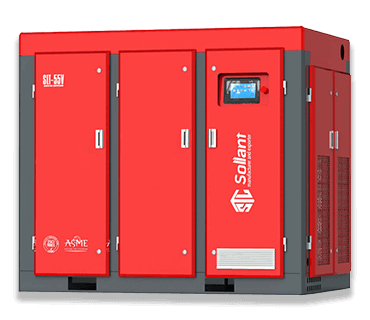
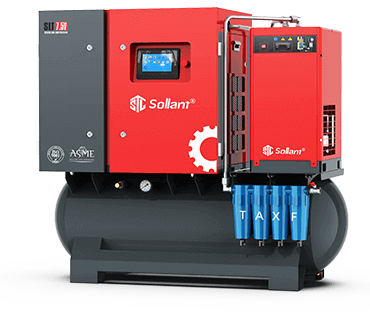
Rotary screw compressors generate continuous airflow through meshing helical rotors. No reed valves, no pulsed flow, 100% duty cycle, flat CFM-to-PSI curve across the operating range. The premium over piston comps is significant. The sustained CFM per dollar over the life of the machine often favors the screw.

Scroll compressors occupy a niche: oil-free, very quiet, modest CFM, dental and lab use. Not competitive on CFM per dollar for shop work.


Sizing Sequence


Start from the tool or tools with the highest combined CFM demand at operating PSI. Add 30% for plumbing losses, altitude correction, ring wear, and future tools. For continuous use, check the duty cycle and double the target CFM if the comp is rated 50%. Verify PSI, which is a formality. Tank size: bigger for intermittent use (fewer motor starts), irrelevant for continuous demand (pump CFM is the constraint). Audit every fitting and hose between tank and tool for flow restriction.

PSI is a threshold. CFM at rated pressure, adjusted for duty cycle, corrected for site altitude and temperature, derated for plumbing losses, and measured with valves and rings that have some hours on them, is the number that predicts whether the comp keeps up with the work. HP is a marketing number. Pump RPM is the mechanical quality indicator the consumer market refuses to print on the box because it would make the price disparity between cheap and good too easy to explain.

Footer Component - SOLLANT
滚动至顶部