Our Products
Compressed Air Solutions
  • Screw Air Compressor
  • Oil Free Compressor
  • Diesel Portable Compressor
  • Gas Compressor
  • Specialty Compressor
  • Air Treatment
ISO 9001 Certified
24-Month Warranty
OEM & ODM Support
Factory Direct Price
All products→
Oil in Compressed Air Lines How to Find and Eliminate the Source
Technical Guide

Oil in Compressed Air Lines: How to Find and Eliminate the Source

Technical Article
22 min read
Oil Contamination

If a plant running a 150-hp rotary screw at maybe 60% average load, cycling all day, with a lubricant brand that got changed eight months ago because purchasing found a cheaper synthetic. That plant has oil in the lines. The maintenance team has been replacing coalescing elements every six months and still getting calls from the paint booth. They think they have a filtration problem because filters are what they keep replacing. They do not have a filtration problem. They have at least two and possibly three upstream problems that the filters are being asked to compensate for.

What the Separator Datasheet Number Actually Means

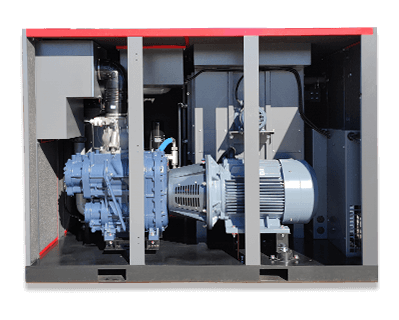
Rotary screw compressor separator system
Oil separator element inside a rotary screw compressor

OEM datasheets rate separator carryover at 2 to 5 ppm. Full load, steady state, design lubricant, rated temperature. Controlled lab conditions. The number is real. It describes what the separator can do when everything lines up.

Nothing lines up in a real plant.

The most consequential variable is loading pattern, and it deserves a level of attention that it almost never gets, so this section is going to be long.

A compressor on load/unload control cycles between full output and zero output. During the unloaded interval, airflow through the separator element drops to near zero. Oil that has started coalescing on the glass fiber media, that has wetted the fibers and started merging into drainable droplets, just stalls. Nothing is moving it down the fibers toward the drain. It sits there in a partially coalesced state. Then the compressor reloads. Pressure builds fast. Airflow surges through the element. That surge hits the stalled oil film and shears it back into fine aerosol and pushes it out the discharge end.

This happens on every single load cycle. Hundreds of times a day on an aggressively cycling machine.

Solberg and Mann+Hummel have both published application data showing carryover during reload transients well above steady-state ratings. The differential pressure gauge on the separator housing shows nothing during these events because the transients are too brief to register. The maintenance team watching that gauge sees a healthy separator. The downstream piping is getting dosed with oil on a schedule synchronized with load cycling.

Now here is what makes this so damaging in practice. Time-average the carryover across a full day of cycling at 50% load and it may run double or triple the datasheet number. With a brand new element. The element is fine. The cycling is producing the carryover. And cycling is what most compressors do, because most compressors are oversized.

A 200-hp machine serving a 120-hp load cycles constantly. A 150-hp machine serving the same load runs at 80% and barely cycles. Same separator element. Dramatically different oil carryover. The sizing decision, made three or five or ten years ago based on pressure and flow requirements with maybe a growth margin thrown in, is now the root cause of an oil contamination problem that nobody connects to the sizing because the connection is not intuitive and not taught.

Compressor sizing meetings are about pressure, CFM, redundancy, maybe energy. Oil carryover at partial load is not a question that gets asked. It should be. But even raising it requires knowing that carryover is a variable that changes with load, and that knowledge is not widespread. Most maintenance teams, most consulting engineers, most compressor salespeople treat it as a fixed machine characteristic.

Adding receiver storage extends cycle times. CAGI recommends at least 1 gallon per CFM for load/unload machines. Receiver tanks are physically boring. Nobody gets credit for specifying a bigger one. A lot of installations have half the recommended volume. A $2,000 receiver tank addition can reduce oil carryover by 30% or 40% on an aggressively cycling compressor by cutting the number of reload transients per hour in half. That is a better return than almost any filter upgrade.

VSD compressor control panel
VSD frequency converter and control interface

VSD compressors solve the cycling issue by modulating speed. At the low end of their speed range, many designs have oil injection controlled thermostatically rather than proportionally to airflow. At minimum rotor speed, the oil-to-air ratio in the compression chamber climbs because the oil flow barely changed while the air volume dropped. The separator sees a heavier oil load at lower velocity, both working against coalescence. OEM specs are at rated speed. Performance at 30% speed is not published.

Here is an aside on VSD compressors that connects to diagnostics rather than to the loading discussion. If a facility runs a VSD unit and the compressor spends significant time at minimum speed, and oil carryover testing is done during a period of high demand when the machine is running fast, the test result will understate the actual average carryover. The worst-case operating point is minimum speed, and that is exactly the point most likely to be missed during a scheduled air quality audit because audits tend to happen during normal production hours when demand is up. If the VSD runs at minimum speed during third shift or weekends, and contamination complaints correlate with those periods, this is probably why.

The Scavenge Orifice

Separated oil drains to the bottom of the separator vessel and returns to the sump through a small-bore line with a precision orifice, roughly 0.8 to 1.2 mm bore. Plugging is in every manual. Oil pools, gets blown downstream.

0.8–1.2mm
Scavenge orifice bore
$200–400
Each unnecessary separator
$1,000+
Wasted before diagnosis

The erosion direction is where plants get stuck in expensive diagnostic loops.

Over thousands of hours, the bore wears wider. A couple tenths of a millimeter. The pressure differential driving oil return through the scavenge line is not large, so a small change in bore diameter creates a proportionally large change in circuit behavior. An oversized bore pulls air backward through the drain path from the clean side, disrupting oil drainage off the separator fibers. Carryover creeps up gradually, steadily. Separator gets replaced. Carryover drops because the new element's tighter fiber structure compensates, then climbs again, faster. Another separator, shorter interval. Another, shorter still. The maintenance team starts questioning separator quality, calls the distributor, maybe tries a different brand.

A pin gauge check would catch this. The orifice costs a few dollars. Each unnecessary separator runs $200 to $400. A plant that goes through three or four rounds before someone checks the orifice has spent over a thousand dollars replacing the wrong part. Field service techs from compressor OEMs recognize this pattern. In-house maintenance teams almost never encounter it because the orifice is treated as a permanent fitting and the troubleshooting checklist ends at the separator element.

Lubricant Changes and What They Do to Separation

"We are running XYZ brand synthetic PAO in a model ABC compressor, your separator part number 12345, is that compatible?"

That phone call to the separator element manufacturer takes five minutes. It almost never gets made.

Lubricant analysis and data logging
Oil analysis and system data logging

Separator fiber media has coatings tuned to specific oil chemistry. Wetting angle, coalescence speed, drainage uniformity. A separator designed for Group II mineral oil handles PAO synthetic differently because the surface chemistry interaction is different. Coalescence may slow. Drainage may become uneven. Carryover climbs.

What typically happens: purchasing or maintenance switches the lubricant. Better price, different supplier, corporate standardization, reliability engineering wants extended drain intervals. Sensible from every angle that gets evaluated. Separator compatibility does not get evaluated because lubricant procurement and separator procurement happen in completely separate administrative workflows. Different budgets, different vendors.

The compressor runs fine mechanically. Temperatures, vibration, oil analysis all normal. Three or six months later, oil carryover is up. Coalescing filters loading faster. Complaints from production. Separator element gets replaced early. Helps a bit, then creeps back. Another separator, same thing. Maybe a second coalescing filter stage gets added. The problem continues because nobody connects it to a lubricant change that happened months before symptoms appeared.

Compressor manuals do not address this because they assume their own lubricant or an equivalent. The separator manufacturer has the data and will share it. The request does not get made because nothing in standard compressor training links lubricant chemistry to separator performance.

Once identified, it is a straightforward correction. Match the separator to the lubricant or the lubricant to the separator. Getting to the point of asking the question is the hard part because the question does not exist in any troubleshooting flowchart.

Monday Mornings

Over a weekend shutdown, condensate and oil settle into every low point and stratify. Oil floats, concentrates. Monday morning startup pushes the concentrated slug ahead of the fresh air. Coalescing filters take a hit they were not sized for.

This is worth dwelling on because of the diagnostic confusion it creates. The air system tests clean during the week. Filters in spec. Compressor healthy. Then Monday morning, paint defects, product rejects, oil sheen on packaging. Investigation Tuesday, finds nothing wrong, because by Tuesday the slug has cleared and the system is back to steady state. Nobody catches the transient because nobody is testing at 6:30 AM Monday.

Draining every low point before pressurization prevents this. That requires drains at every low point, which many piping systems lack, and functioning drains at the points that have them. CAGI-certified auditors consistently find around a third of drain traps nonfunctional in typical facilities. Float drains stick. Timer drains get set once. Zero-loss electronic drains cost more and work.

Piping layout contributes to this more than most people realize. Branch connections from the side or bottom of a header give pooled liquid a gravity path straight into the branch. Connections from the top prevent it. Every piping reference says top. Most installations have side taps because they are easier to make during construction.

Oil Vapor and Discharge Temperature

At compression temperatures, lubricant partially vaporizes. Gas-phase hydrocarbon. It passes through coalescing filters, water separators, and particulate filters without being affected by any of them.

Concentration roughly doubles for every 15°F of additional discharge temperature. This relationship is exponential and it makes discharge temperature the single most leveraged variable in the entire oil contamination picture. A dirty oil cooler does not just shorten bearing life. A failed cooling fan is not just a reliability issue. A compressor room with poor ventilation and hot exhaust air recirculating back to the cooling inlet is not just an energy waste. All of these are oil vapor sources. And the vapor load they produce has to be dealt with by an activated carbon bed that has a finite capacity and a replacement cost.

Activated carbon filtration system
Downstream filtration and carbon adsorption

PAO synthetics generate less vapor than mineral oil at equivalent temperature because lower vapor pressure. Lubricant suppliers promote this. What they do not promote is that PAO vapor molecules are structurally uniform and nonpolar, and activated carbon adsorbs them less readily than the irregular hydrocarbon mix in mineral oil vapor. Generation goes down. Capture goes down. The net change at the point of use has to be measured. Sometimes it is significant. Sometimes it is disappointing.

Carbon beds exhaust silently. No pressure drop change. No alarm. Quarterly outlet testing with vapor-phase detector tubes from Dräger, Gastec, or Kitagawa is how bed life gets monitored. Without it, the carbon adsorber is a black box that may or may not be doing anything. Bed life varies enormously between installations. A tight system might get well over a year. Elevated discharge temperature and degraded upstream coalescing elements can exhaust the same bed in under six months.

Carbon goes downstream of coalescing filtration because liquid aerosol reaching the granules destroys adsorption capacity far ahead of normal saturation.

Finding It

White cloth blowdown at point of use catches gross liquid contamination. Smell catches petroleum and PAO lubricants but not ester synthetics. Detector tubes give field-level ppm readings. Separate types for aerosol and vapor. Both needed at each point.

Sample probe position in the pipe matters. Aerosol concentrates toward the bottom of horizontal runs. ISO 8573-2 specifies center-third positioning. Samples from bottom drain taps read high.

Sequential sampling from the compressor outward, under the actual operating pattern rather than a staged full-load demo, isolates where contamination enters. Compressor discharge first. Then after the aftercooler. Then after each coalescing filter, where a 0.01-micron element should bring aerosol below 0.01 ppm. Then after the carbon adsorber with a vapor tube.

Coalescing filter bypass deserves its own mention because it is the most common cause of coalescing filter underperformance and is invisible from outside the housing. A cracked end cap, a pinched O-ring, a scored housing bore. Air goes around the element while differential pressure reads normal. Two minutes of inspecting the sealing surfaces during each element change catches it. Most procedures do not include the inspection.

When upstream readings are clean and the point of use is not, the piping is the source. Walls coated with hydrocarbon deposits from prior contamination keep shedding for months after upstream problems are corrected. Heavy varnish, the thick brown or black coating visible when a fitting is cracked open, does not clear on its own and those sections need replacement. Light deposits clear slowly with clean air flow.

Corrections

Compressor maintenance and correction procedures
Systematic correction and verification workflow

Separator element and scavenge orifice together. Pin gauge on the orifice. Oil level checked while running because running level differs from static level and overfilling at standstill floods the separator under pressure. Lubricant-separator compatibility confirmed with the element manufacturer if the oil has ever been changed. Discharge temperature within spec, which means cooler, fan, ventilation, recirculation all addressed. Receiver volume for cycling machines, at least 1 gallon per CFM.

Downstream: bulk water separator with zero-loss drain, 1-micron coalescing filter, 0.01-micron coalescing filter, activated carbon. Coalescing elements on time-based replacement at twelve months or 8,000 hours regardless of differential pressure, because differential pressure indicates restriction and not coalescing efficiency and those are different things that degrade on different timelines. Carbon on the schedule that quarterly outlet testing establishes.

Headers sloped 1% toward drip legs. Branch connections from the top. Contaminated pipe sections replaced.

Oil-Free Compression

Oil-free compressors eliminate lubricant from compression. Purchase price 30% to 60% above oil-lubricated units based on published OEM pricing. Total ownership cost closer when the downstream treatment tail is included. For food, pharma, electronics, coating applications, the total comparison is worth running. For general plant air running cylinders and hand tools, usually not.

30–60%
Oil-free price premium
12 mo
Coalescing element replacement
1 gal/CFM
Min. receiver volume

Measurement

Quarterly sampling at the compressor discharge and after each treatment stage. Log results. Compare quarter to quarter. An upward drift is a maintenance signal. The testing takes an hour.

Footer Component - SOLLANT
滚动至顶部