Our Products
Compressed Air Solutions
  • Screw Air Compressor
  • Oil Free Compressor
  • Diesel Portable Compressor
  • Gas Compressor
  • Specialty Compressor
  • Air Treatment
ISO 9001 Certified
24-Month Warranty
OEM & ODM Support
Factory Direct Price
All products→
How to Design a Compressed Air System for Manufacturing Plants
Technical Guide

How to Design a Compressed Air System for Manufacturing Plants

25 min read
System Design

What most facilities have is a collection of equipment purchased over fifteen or twenty years, each piece bought to solve whatever problem was loudest that month. A new production line went in, pressure dropped, somebody ordered another compressor. The pipes were routed by a pipefitter who had a week. The dryer came bundled in a package deal with the compressor and nobody checked whether it was the right type.

The DOE compressed air sourcebook puts average system efficiency at around 12% from electrical input to useful work at the point of use. Eighty-five to ninety cents of every dollar of electricity going into the compressor turns into heat, escapes through leaks, or gets wasted as pressure no machine on the floor actually needed. At a lot of plants compressed air is the single largest electrical load, bigger than process equipment, bigger than HVAC.

A system that was engineered as a whole versus one that accumulated by emergency purchase order: the energy cost gap between those two runs 30 to 50 percent, compounded over the fifteen to twenty-five year life of the equipment.

What passes for demand data at a typical plant is a number someone calculated during the original design, possibly revised once during an expansion, and never checked against what the floor actually uses today. That number might be fifteen years old. The plant has changed since then. Machines added, lines reconfigured, shifts adjusted, whole sections of the building repurposed without anyone going back to update the air calculations.

Manufacturing plant floor

The floor walk comes first. Tag every device that uses compressed air. What pressure does it need. What flow rate does it draw. What fraction of the operating day does it actually run. In a medium-sized plant that could be two or three hundred devices, and a good number of them will not be where the drawings say they are. Nameplate ratings are not reliable. Manufacturers rate for worst case. A pneumatic cylinder rated at 8 CFM that fires every thirty seconds draws maybe 2 or 3 CFM averaged over the cycle, depending on bore, stroke, and frequency. Nameplate totals across a whole plant can overstate real consumption by 40% or more. Designing to nameplate is how systems end up with double the compressor capacity they need.

Diversity factor: the fraction of equipment actually running at the same time. On a synchronized automotive line, 0.85. A job shop with thirty CNC machines and twelve cutting at any moment, maybe 0.5. Plants with lots of short-cycle pneumatic clamps spread across independent stations can be below 0.4. CAGI publishes estimation guidance and standardized data sheets for comparing performance across manufacturers.

None of which replaces measurement. Rent a data logger, put it on the main header, record for two full weeks across all shifts. Two weeks minimum because shorter windows miss the odd patterns: changeover days, deep-clean shifts, the week when a major line is in maintenance and demand looks artificially low.

The shape of the curve matters as much as the peak. A plant hitting 2,000 CFM on first shift, 800 on second, 200 on weekends has a completely different compressor need than one holding 1,500 around the clock. The compressor selection, VSD sizing, receiver volume, sequencer programming: all of it traces back to that curve.

Padding demand "for growth" is common and usually excessive. If a specific expansion is planned, quantify the additional demand and include it. If nothing concrete is on the table, 10% margin and stop. A compressor that loads and unloads all day because the plant only needs two thirds of its output is burning electricity on every cycle for capacity that may never get used.

Each 2 PSI of unnecessary pressure costs approximately 1% in additional energy. On a 200 HP machine running 8,000 hours a year at ten cents per kilowatt-hour, that is real money even at modest overpressure.

The relationship between discharge pressure and energy cost is about 1% additional energy per 2 PSI of unnecessary pressure, which the DOE sourcebook derives from basic thermodynamics. On a 200 HP machine running 8,000 hours a year at ten cents per kilowatt-hour, that is real money even at modest overpressure.

Nearly everything on the floor runs at 90 PSI. Then one station needs 120, so the whole system gets set to 125 because turning up the regulator takes five minutes and does not require a purchase order. That setting stays for years. A booster at the high-pressure station or a small dedicated compressor for the outlier solves the problem without penalizing the rest of the network, but these options require someone to actually evaluate the demand at that one point.

Pressure control equipment
Pressure Optimization

Reducing Discharge Pressure Without Production Impact

A pressure/flow controller downstream of the primary receiver holds plant pressure within plus or minus 1 to 2 PSI regardless of what the compressors are doing on the supply side, and installing one allows a 10 to 15 PSI reduction in discharge pressure with no production impact. Equipment vendors almost never include these in proposals.

For distribution losses, budget 3 to 5 PSI across treatment equipment, another 3 to 5 across piping. If the tools need 90, set the compressor at 100 to 108 depending on the age and condition of the piping. Every PSI above that increases leak flow, accelerates wear, and adds to the electricity bill. Leak flow through a given orifice is roughly proportional to supply pressure, so a system at 125 loses about 25% more air through the same holes compared to one at 100.

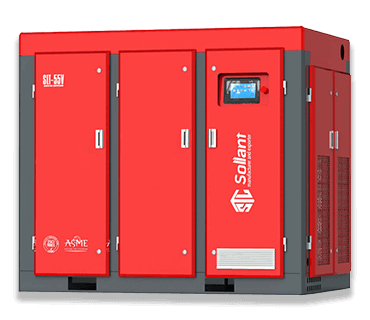
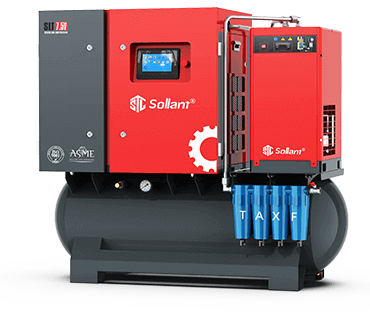
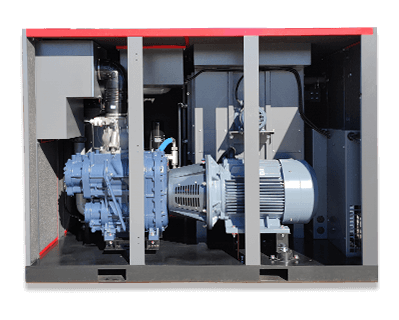
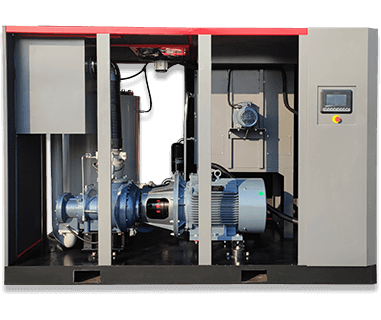
Rotary screw compressors dominate the 25 to 500 HP range. Continuous duty, reasonable footprint, broad service network, strong parts availability. In a production environment the service infrastructure matters as much as the efficiency numbers.

Rotary screw compressor
25–500 HP

Rotary Screw

Centrifugal compressor
Above 1,000 HP

Centrifugal

Compressor monitoring
5–25 HP

Reciprocating

For small operations or intermittent loads, two-stage reciprocating compressors in the 5 to 25 HP range are simpler, cheaper to maintain, and last well past thirty years. The industry has pushed rotary screw into applications where a recip would have been the right answer, partly because the service contracts are more lucrative. Above 1,000 HP, centrifugal compressors deliver excellent full-load efficiency but have a narrow operating range and a hard surge limit. Plants at that scale generally have engineering teams making the selection.

Oil-free machines carry a 30 to 50 percent premium. ISO 8573-1 defines air quality classifications, and Class 0 and Class 1 oil limits cannot be reliably met by oil-flooded compressors with downstream filtration. Oil carryover increases with ambient temperature, oil age, and filter element loading, and under real conditions the downstream coalescent filter cannot consistently hold Class 1 limits. Food, pharma, semiconductors, electronics: oil-free is the engineering requirement.

Pair a fixed-speed compressor sized for the minimum continuous load with a VSD unit that covers everything above that baseline. The fixed-speed machine runs near full capacity where it is most efficient. The VSD adjusts in real time. The combination cuts energy consumption by 15 to 35 percent compared to a single oversized fixed-speed machine on load/unload.

VSD units have a minimum speed around 20 to 25 percent of rated capacity, and below that they cycle like a fixed-speed machine. If the base-load compressor is too large, the VSD sits below minimum speed too much of the day. Getting the split right requires the demand profile from data logging.

Redundancy: N+1 at minimum. If two compressors handle peak demand, buy three. Whether the standby sits cold or runs at partial load depends on the production cost of unplanned downtime.

80 to 93 percent of the electrical energy going into a compressor becomes heat. Recovery options include heated coolant loops, plate heat exchangers on the oil circuit, warm exhaust air ducted into the plant for space heating. All dramatically cheaper to install during the original build than to retrofit.

A compressor trips and the line stops within minutes and everyone knows. A dryer that is falling behind on moisture removal is a different kind of failure. Wet air moves downstream for weeks. The symptoms show up far from the cause: water in pneumatic cylinders three hundred feet from the compressor room, corrosion inside valve bodies, reject product on the packaging line. Maintenance staff swap regulators and blow out water traps at the tools. The dryer is not even on the suspect list until someone runs out of other things to replace.

The chain of events is worth tracing because it reveals how aftercooler performance, dryer sizing, compressor room ventilation, and ambient conditions interact in ways that the individual equipment specifications do not capture.

Aftercoolers are built into most compressor packages and treated as solved. An aftercooler is a heat exchanger. It has a rated ambient temperature. An aftercooler rated for 100°F ambient sitting in a compressor room that reaches 115°F in summer cannot pull the discharge air temperature down as far as the dryer expects. The dryer was sized for an inlet temperature based on the aftercooler hitting its rated performance. When the room overheats, the aftercooler falls short, excess moisture reaches the dryer, and one of two things happens depending on the dryer type.

Air treatment and drying equipment

A refrigerated dryer sees higher inlet temperature and higher moisture load than it was designed for, and its outlet dew point rises. If it rises above 39°F, condensation starts occurring in the distribution piping downstream. A desiccant dryer sees the same excess moisture and its desiccant bed saturates faster than the regeneration cycle can recover, which drives the outlet dew point up progressively over days or weeks until it eventually breaks through the target spec.

A thermocouple or RTD between the aftercooler outlet and the dryer inlet, trended against outdoor temperature and compressor room temperature, catches this early. Without that measurement the problem is invisible until the floor starts complaining about wet air.

The diagnostic path from "wet air at the paint booth" back to "compressor room temperature is fifteen degrees above the aftercooler's rated ambient" can take weeks. Maintenance staff replace regulators, blow out moisture traps, check the dryer, change the dryer filter, and still get complaints. Eventually someone checks the compressor room temperature and finds the answer. The fix might be as simple as adding a ventilation fan or cleaning a clogged intake filter on the room. But the weeks of troubleshooting and the reject product and the corroded valve bodies have already happened.

Refrigerated dryers handle most general manufacturing at 35 to 39°F pressure dew point. Desiccant dryers go to minus 40°F or lower, necessary for outdoor piping in freezing climates, instrument air, and painting operations.

15–18%
Heatless Purge
5–7%
Heated Purge
<2%
Blower Purge
0%
Heat of Compression

The desiccant dryer category splits into several regeneration types and the operating cost differences between them are large enough to be worth examining in detail.

Heatless desiccant dryers use 15 to 18 percent of rated flow as purge air. On a 1,000 CFM unit that is 150 to 180 CFM of compressed air that was produced at full energy cost, run through the entire treatment chain, and then dumped to atmosphere to dry the desiccant bed. Every hour, continuously, as long as the dryer runs. For comparison, 150 CFM is enough to run several production machines. That air is being made and immediately thrown away. Heated regeneration drops purge to around 5 to 7 percent. Blower purge drops it below 2. Heat-of-compression designs eliminate purge entirely but require integration with specific compressor types.

For units above 500 CFM running continuously, the energy savings from choosing a blower purge or heated dryer over a heatless design pays off the capital premium within a couple of years. Below that, or for intermittent operation, heatless has genuine value because the mechanism is simpler and there are fewer components to maintain.

Dewpoint-dependent switching monitors the outlet and triggers regeneration only when the desiccant actually needs it. A sensor and control board add a few thousand dollars.

Dryers with timer-based regeneration switch towers on a fixed schedule regardless of moisture load. At 3 AM on a Sunday with the plant idle, the towers still cycle, wasting purge air to regenerate a bed that does not need regeneration. Dewpoint-dependent switching monitors the outlet and triggers regeneration only when the desiccant actually needs it. For plants with variable demand patterns the improvement is meaningful. A sensor and control board add a few thousand dollars.

The desiccant media itself matters in ways the specification sheet does not make obvious. Activated alumina is the most common fill and handles a wide temperature range but is susceptible to damage from liquid water carryover, which brings the discussion back to aftercooler performance. If liquid water reaches the desiccant bed because the aftercooler cannot keep up in summer, the alumina degrades and the dryer's rated dew point specification becomes meaningless regardless of what the nameplate says. Molecular sieve media provides deeper dew points and better liquid resistance but costs more and needs higher regeneration temperatures, which makes it a poor match for heatless designs. Silica gel has the highest moisture capacity per unit weight but degrades faster under repeated thermal cycling. The interaction between media type, aftercooler performance, regeneration method, and operating environment is where dryer problems actually originate, and none of it shows up in a headline dew point spec on a vendor quote.

Filtration: coalescing pre-filter upstream of the dryer, particulate after-filter downstream, activated carbon if oil-free air is required. Housing size is where problems accumulate over time because a filter element loads with contaminant and pressure drop climbs as it does. An undersized housing that starts at 2 PSI of drop may be at 5 to 8 within weeks. Many plants run elements far past the point they should be replaced. That pressure penalty applies to every cubic foot of air in the system. A larger housing slows the pressure rise curve, extends element life, and costs very little more.

Drains: zero-loss demand type at every low point, receiver, and filter bowl. Manual drains do not get opened on any consistent schedule regardless of what the maintenance plan says. Timer drains blow compressed air whether condensate is present or not. Zero-loss drains open only when condensate reaches a threshold.

Ring main. Air reaches any point of use from two directions, velocity halves, pressure drop falls to a quarter because it goes as the square of velocity. Where a full loop is not feasible, cross-connect the major branches.

Industrial piping system

Velocity targets: below 20 ft/s in the header, below 30 in branches. Going up one pipe size on the header costs little during installation. Piping outlasts every compressor and dryer in the system.

Aluminum for new installations: no internal corrosion, fast installation, easy reconfiguration. Black iron corrodes inside and sheds scale. Stainless for cleanroom and pharma. PVC is prohibited by OSHA for compressed air because it shatters under pressure rather than splitting. Same for CPVC and ABS.

Fittings add drop and leak points. A 90° elbow on 2" pipe equals about 5 feet of straight pipe in pressure drop. Long-radius elbows cut that in half. Crane Technical Paper 410 has detailed equivalent lengths across pipe diameters and fitting types. Minimize direction changes in routing.

Slope horizontal runs 1 to 2 percent downward in the direction of flow. Drip legs at every low point, dead end, and riser. Branch connections from the top of the header because condensate rides along the bottom.

Primary wet receiver between the compressor and dryer: 1 gallon per CFM of compressor capacity as a starting point. Systems with VSD compressors or variable demand should go larger because the receiver is the buffer that lets the VSD modulate smoothly.

Receiver tanks get cut from project budgets more often than any other component.

For sudden large draws at specific points, a local receiver close to the machine matters more than central tank size. A 120-gallon tank twenty feet from a blow mold outperforms a 500-gallon tank three hundred feet away during a short heavy draw because pressure drop in the connecting pipe eats the stored energy. Sizing equation for local receivers: V = T × (C − S) × 14.7 / (P1 − P2), where T is event duration in minutes, C is demand CFM, S is supply CFM from the distribution system, P1 and P2 are upper and lower acceptable pressures in PSIA.

Without a sequencer, compressors on individual pressure bands fight each other. One loads while another unloads. Two start on the same dip. Three run at partial load when one at full load would cover demand. A sequencer assigns priority, manages delays, holds a single pressure band.

Pressure monitoring
Monitoring

Pressure Transducers

Power metering equipment
Efficiency

kW per 100 CFM

Instrumentation: flow meters at compressor discharge and major branches, pressure transducers across the network, power meters on each compressor for specific power tracking, dew point sensors after dryers. Specific power is useful as a trend metric because a machine reading 22 kW per 100 CFM when it commissioned at 18 has a problem developing.

Ultrasonic leak detection
Detection

Finding Invisible Waste

Compressed air leaks are invisible. There is no liquid on the floor. No discoloration. No odor. A water leak or an oil leak produces physical evidence that someone notices and the maintenance system responds to. Compressed air produces nothing. The electricity bill goes up gradually and the increase gets absorbed into the baseline, attributed to production volume or rate changes. The hissing fitting behind a machine is inaudible over production noise. The maintenance system never engages because nothing triggers it.

This is not a technical problem. It is a visibility problem. It explains why plants that are otherwise well-maintained carry leak rates above 25 percent for years without anyone raising the question. The DOE average for plants that have never run a detection program is 20 to 30 percent of total compressor output. Older plants with galvanized or iron piping often exceed that range, especially at threaded connections where corrosion has eaten into the thread sealant.

A quarter-inch orifice at 100 PSI bleeds about 100 CFM. A medium-sized plant that has never been surveyed may have several hundred individual leak points ranging from pinhole hose cracks to loose quick-connect couplings to improperly sealed threads. The aggregate can be enormous.

Leak rates do not hold steady on their own. New leaks develop as fittings vibrate, hoses age, quick-connects wear, seals degrade. Without active intervention, the number only grows.

Some newer acoustic imaging cameras can visualize leak locations on a display in real time, which speeds up surveys compared to traditional point-and-listen probes.

An ultrasonic detector, $3,000 to $5,000 for a capable handheld unit, finds leaks during normal production. It picks up the ultrasonic frequency component of turbulent flow at the leak, above the frequency range of ambient industrial noise. Some newer acoustic imaging cameras can visualize leak locations on a display in real time, which speeds up surveys compared to traditional point-and-listen probes.

Quarterly survey process: walk the plant, tag each leak with a physical label, estimate the flow, repair, record. Most repairs are ordinary. Tightening a fitting. Replacing a quick-connect coupling. Swapping a cracked hose. Applying thread sealant to a connection assembled dry. Commodity parts, standard maintenance labor.

The first survey at a plant that has never done one produces the biggest improvement. Subsequent cycles find fewer leaks. Plants sustaining a quarterly program for two years get below 10%. The trend data from successive surveys also shows which connection types and plant areas generate the most new leaks, which feeds decisions on piping material upgrades or equipment replacement.

500K
BTU/hr per 200 HP
~2%
Output Loss per 10°F
75–85dBA
Full Load Noise

A 200 HP compressor puts around 500,000 BTU/hr of heat into the room. Each 10°F rise in inlet air temperature reduces output about 2% and raises energy consumption about 1% per the DOE. Three large machines in a poorly ventilated room can push past 120°F in summer. Filtered outside air intake for the compressor inlet, separate exhaust to pull heat out. In cold climates, dampers on the exhaust can redirect warm air into the plant for winter heating.

Maintenance clearance gets shortchanged during layout. Pulling an airend, swapping a motor, servicing a dryer tower: these jobs need space, some need crane access. An 18-inch gap between machines means deferred maintenance for the life of the installation.

Noise: 75 to 85 dBA at full load. Acoustic treatment during construction.

Condensate: oil-water separator piped to all drain points, part of the original design. Oil-laden condensate is regulated discharge in most jurisdictions.

Compressor room layout

The individual components are mature products. The waste accumulates in the connections between them. A pipe one size too small. A receiver cut from the budget. A sequencer never programmed to match the demand profile. Leaks that go undetected.

A high-efficiency compressor connected to leaking pipes loses the saved energy through the leaks. A desiccant dryer sized for rated flow gets overwhelmed if the aftercooler upstream cannot keep up in summer. A receiver provides no benefit if the sequencer starts another compressor rather than using stored pressure.

Start with demand data. Set pressure as low as the process allows. Match compressors to the load profile. Treat air to the quality the product requires. Pipe it in a properly sized aluminum loop. Put receivers where the spikes occur. Run a sequencer. Monitor specific power. Fix leaks quarterly.

The compressor purchase is nearly always driven by a production emergency. A line goes down, pressure drops, someone needs a compressor by next month. The system grows by one more piece of equipment selected to fix the immediate symptom. That cycle repeats for fifteen or twenty years, and by the end the electricity bill is double what a designed system would have produced. The engineering has to happen before the purchase order, and the purchase order almost never waits.

Footer Component - SOLLANT
滚动至顶部