Our Products
Compressed Air Solutions
  • Screw Air Compressor
  • Oil Free Compressor
  • Diesel Portable Compressor
  • Gas Compressor
  • Specialty Compressor
  • Air Treatment
ISO 9001 Certified
24-Month Warranty
OEM & ODM Support
Factory Direct Price
All products→
How Altitude and Elevation Affect Air Compressor Performance
Technical Guide

How Altitude and Elevation Affect Air Compressor Performance

Technical Article
18 min read
Altitude

Atmospheric pressure at sea level is approximately 14.7 psi. At 10,000 feet, it drops to about 10.1 psi. The cylinder volume or screw displacement of a compressor does not change with altitude. The same displacement volume at 10,000 feet contains roughly 26% fewer air molecules than at sea level. The CFM on the nameplate is volume flow. The equipment downstream consumes mass flow. These two quantities are approximately equal at sea level. The higher the altitude, the wider the gap. Most high-altitude compressor problems start from this gap.

14.7 psi
Pressure at sea level
10.1 psi
Pressure at 10,000 ft
26%
Fewer air molecules

Compression Ratio

This is the single aspect of altitude's effect on compressors where consequences concentrate most heavily, and it warrants proportionally more space.

A compressor delivering 100 psig at sea level works against a discharge absolute pressure of approximately 114.7 psia, with intake at 14.7 psia, giving a compression ratio of 7.8:1. At 10,000 feet, intake pressure drops to 10.1 psia, discharge absolute becomes 110.1 psia, and the compression ratio jumps to 10.9:1. This 40% increase does not appear on the nameplate. Inside the compressor, it is felt everywhere.

7.8:1Ratio at sea level
10.9:1Ratio at 10,000 ft

The adiabatic compression discharge temperature formula T2 = T1 × (P2/P1)^((k-1)/k), with k at 1.4, has a shape that determines one thing: the temperature rise from a compression ratio of 7.8 to 9, and the temperature rise from 9 to 10.9, are not in the same magnitude. The latter segment is far steeper. At sea level, a single-stage reciprocating compressor might show discharge temperatures between 280°F and 300°F. At 10,000 feet, the same machine can run above 380°F. Most single-stage units have high-temperature shutdown protection set between 325°F and 350°F. This means the 10,000-foot operating condition can push the machine straight into its protective shutdown zone. Not "reduced performance." "Won't run" or "runs for a while then stops."

Below 300°F, the oxidation rate of mineral-based compressor oil remains relatively manageable. For roughly every 18°F (10°C) increase in temperature, the oxidation rate approximately doubles. This is a rough engineering approximation of the Arrhenius relationship; specific numbers vary between oil products, but the order-of-magnitude relationship holds. The span from 300°F to 380°F is enough to compress oil life from a nominal 4,000 hours to below 1,500 hours. The carbon buildup rate on intake and discharge valve plates has a similarly nonlinear relationship with temperature. A reciprocating compressor that gets valve maintenance once a year at sea level may need it every four to five months at 10,000 feet. This maintenance cost increase is rarely evaluated seriously during the equipment procurement phase.

Two-stage reciprocating compressors split this compression ratio apart. Between the two stages sits an intercooler, and each stage handles a much lower compression ratio. At sea level, the choice between two-stage and single-stage mainly affects the electricity bill. Above 8,000 feet, the choice between two-stage and single-stage affects whether the machine can keep running at all. That is a difference in kind, not in degree.

Screw compressor rotor assembly

The compression ratio problem in screw compressors presents itself differently. The Atlas Copco GA series, the Ingersoll Rand R series, the Kaeser BSD/CSD series, these mainstream models all have a built-in volume ratio (Vi) fixed at the time of manufacture. Vi is determined by the rotor profile geometry and the discharge port position, locked in during production. The standard Vi for GA 30 through GA 90 falls roughly between 3.5 and 4.5, corresponding to rated discharge pressures of 7 to 8 bar at sea level.

At sea level, when Vi is well matched, the pressure inside the compression chamber at the moment the discharge port opens equals the system line pressure. This is the most efficient operating state.

At 10,000 feet, the pressure ratio the system requires exceeds the Vi's design range. When the discharge port opens, the pressure inside the chamber is lower than the line pressure. High-pressure gas surges back from the discharge piping into the compression chamber. This is under-compression.

The energy loss from under-compression can be seen directly on a PV diagram using the area method. The irreversible expansion that occurs when the backflowing high-pressure gas mixes with the lower-pressure gas inside the chamber converts energy into heat and noise. In engineering terms this is quantifiable: each 1% of under-compression corresponds roughly to 0.3% to 0.5% degradation in specific power, with the exact coefficient depending on the specific rotor profile. At high altitude, the under-compression magnitude can reach 15% to 20%, and the corresponding additional energy consumption is substantial.

The effect of backflow pulses on bearings falls outside the domain of energy loss and inside the domain of fatigue life. Each backflow event is an impact load, small in magnitude, synchronized with rotational speed. In the L10 life calculation for angular contact ball bearings and cylindrical roller bearings, there is a dynamic equivalent load term, and pulse loads are factored in through a correction coefficient. The correction coefficient under under-compression conditions can reduce L10 life to 60% to 70% of the rated value. This is a theoretical estimate; the engineering manuals from bearing manufacturers (SKF, NSK, Schaeffler) contain detailed pulse load correction methods.

The Atlas Copco VSD+ series and the Kaeser SFC series have wide-range adjustment capability and much better adaptability to varying pressure ratios. When it is known at the procurement stage that the installation altitude exceeds 8,000 feet, the additional purchase cost of these models is typically recovered within a two-to-three-year operating cycle through savings in bearing life, energy efficiency, and maintenance expenses.

Manufacturer Derating Tables

Compressor manufacturer manuals all contain altitude derating tables or derating curves. They can be found in Sullair product manuals, CompAir selection guides, and Ingersoll Rand technical documentation.

How this data is generated: sea-level acceptance test data per ISO 1217 Annex C is fed into the standard atmosphere model to calculate intake density at the corresponding altitude, then multiplied by a volumetric efficiency correction factor to produce the derated FAD. Most manufacturers do not have test facilities built at high altitude. Constructing a test setup at 10,000 feet that meets the accuracy requirements of ISO 1217 Annex C would require, just for starters, a calibration standard air source at the corresponding altitude conditions for the intake and discharge flow measurement systems, and the investment only grows from there.

The volumetric efficiency correction factor is the weakest link in this calculation chain. The clearance volume effect in reciprocating compressors is nonlinear. When the piston reaches top dead center, a pocket of high-pressure air remains in the cylinder. During the next intake stroke, this trapped air must expand until its pressure drops below intake pressure before the intake valve will open. The lower the intake pressure, the longer the expansion stroke, the shorter the effective stroke available for fresh air. The nonlinearity of this relationship becomes quite pronounced above 12,000 feet, enough to push volumetric efficiency an additional four to six percentage points below the linear extrapolation value.

The source of derating error in screw compressors is different. At high altitude, the pressure differential across the rotor clearance gaps increases (discharge pressure unchanged, intake pressure lower), and leakback through the gaps increases. How much this increase amounts to depends on the specific clearance dimensions, the sealing effectiveness of the oil film, the rotational speed, and how many hours the unit has already operated (clearances slowly grow with operating time). Accurate modeling requires CFD, and that step is not included in the standard derating process.

ISO 1217 Annex C has explicit requirements for test conditions, while its guidance on how to convert results to nonstandard altitudes is more of a framework nature. The CAGI Data Sheet format requires manufacturers to note test conditions but does not mandate a uniform conversion method. The result is that derating tables from different manufacturers, while referencing the same standard, use different conversion methods with different degrees of conservatism.

Within the sea level to 5,000-foot range, the differences are nearly invisible. At 10,000 feet, the gap between derating numbers from two brands for equivalent-class units can grow large enough to swing a selection decision. If two machines look similar on their sea-level CAGI sheets, which one to pick at high altitude depends on whose derating numbers are more trustworthy. And "more trustworthy" is hard to judge without actual test data at the corresponding altitude.

For projects at altitudes above 10,000 feet, adding 10% to 15% margin on top of the manufacturer's derated values is a pragmatic approach.

Oil and Oil Separation

In oil-injected screw compressors, the oil inside the compression chamber gets sheared into a mist by the airflow. When air density drops, the shearing force of the airflow on oil droplets weakens, and the mist particles become coarser. Coarse oil mist forms a less uniform oil film on the rotor surfaces than fine mist, increasing the probability of localized areas where the film is too thin. Rotor profile accuracy is slowly lost, clearances slowly grow, internal leakage slowly increases. This process spans thousands of operating hours. Vibration monitoring and oil analysis both have difficulty catching it during this phase. By the time a capacity test reveals that output has deviated from baseline by 15%, the maintenance records for the preceding two years all say "normal." This failure mode is particularly unwelcome because there is no low-cost monitoring method that can catch it early.

The coalescing filter element inside the oil separator vessel has a design velocity window. At high altitude the velocity distribution through the filter shifts, and separation efficiency drops. For units with a nominal residual oil content of 1 to 3 ppm, downstream oil content rising above 5 ppm at 10,000 feet is possible. The additional oil entering the refrigerated dryer accumulates on the evaporator heat exchange surfaces, reduces heat transfer efficiency, and causes the outlet pressure dew point to drift slowly. A fraction of a degree per day, invisible against normal reading fluctuations. After a few months it adds up to several degrees. That said, the dryer's heat exchange surfaces are simultaneously contending with dust on fins, refrigerant charge deviations, and seasonal ambient temperature swings, so isolating the dew point drift and attributing it solely to the altitude-related change in oil separation efficiency is not operationally feasible on site.

Engine-Driven Units

Engine-driven portable compressor

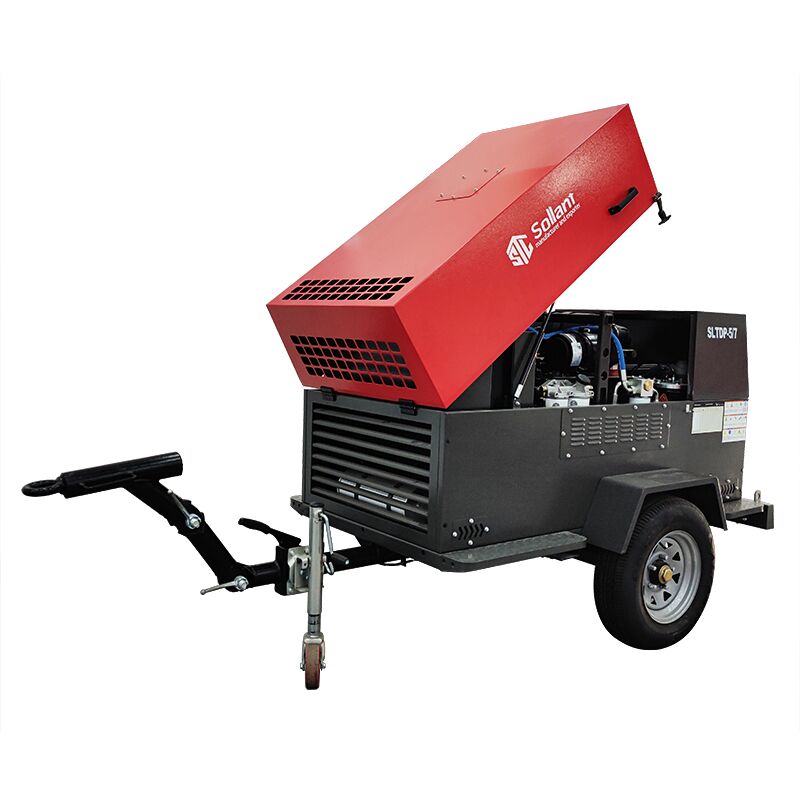
Ingersoll Rand, Doosan, and Sullair towable compressors are everywhere on mine sites and construction sites. The diesel engine and the compressor each take a separate altitude loss, and the two stack. Naturally aspirated engines lose approximately 3% of rated power per thousand feet. Mass flow on the compressor side drops simultaneously. Turbocharged engines recover most of the power deficit on the engine side but do nothing for the air density at the compressor intake. These are two completely independent air paths.

Why Failures Are Not Evenly Distributed

Below 6,000 feet, most industrial screw compressors run with all parameters inside design margins, showing no significant anomalies. Above 8,000 feet a pattern emerges: machines do not get gradually worse in a smooth decline, but rather develop concentrated problems within a relatively short time window.

The underlying reason: multiple subsystems each have their own tolerance boundaries. While still within those boundaries, they each independently absorb the pressure that altitude imposes. Once one subsystem is the first to cross its boundary (usually discharge temperature reaching the accelerated oxidation zone for the oil), it transmits its thermal burden to adjacent subsystems. Oil degradation reduces sealing performance. Reduced sealing increases leakage. Increased leakage pushes discharge temperature higher. Higher discharge temperature further accelerates oil degradation. Once this loop activates, it converges toward shutdown. The transition from "running with occasional high-temperature alarms" to "continuous trips, unable to restart" can sometimes be a matter of one or two weeks.

The 8,000-foot figure is a rough empirical dividing line. Units with generous design margins can be pushed to 9,000 or even 10,000 feet before problems appear. Units where margins were already tight might start having issues at 6,500 feet.

Barometric Pressure Fluctuation

Derating calculations use the fixed barometric pressure values from the standard atmosphere model for the corresponding altitude. Weather systems can push local barometric pressure 15 to 25 mbar below the standard value. At sea level, 25 mbar against the 1013 mbar baseline is 2.5%. At 15,000 feet, where standard pressure is approximately 572 mbar, the same 25 mbar represents close to 4.4%. A compressor already running at its tolerance margin at high altitude may trip during a low-pressure weather passage because of these additional few percentage points. The operators see that the altitude hasn't changed, the load hasn't changed, everything looks the same as usual, and the machine inexplicably shut down on high temperature.

Put a recording barometer at the high-altitude installation site. When alarms happen, line up the timestamp against the barometric reading.

Sizing

Determine how much air the end-use equipment needs: at what pressure, at what flow rate. Multiply the flow rate by the correction factor (sea-level pressure divided by local pressure). The correction factor at 10,000 feet is approximately 1.455. A 150 CFM end-use demand corresponds to approximately 218 CFM at sea-level rating.

1.455Correction factor at 10,000 ft
150 → 218CFM demand vs. rated CFM

This is the point where most sizing work stops. There are several more things to do. Confirm that the selected compressor can keep its discharge temperature within the design envelope at a 10.9:1 compression ratio. Recalculate the piping pressure drop, because a larger compressor means more volume flow running through the piping than the sea-level design value, pipe diameters haven't changed, velocity is up, friction losses are up, and a 3 psi sea-level pressure drop becomes 5 to 6 psi at high altitude. For engine-driven units, the prime mover derating also needs its own calculation: the higher compression ratio increases the compression work per unit of delivered air, the engine's available power is simultaneously decreasing, both sides squeezing the margin, and the margin is smaller than assumed.

For mobile units that transfer frequently between job sites at different altitudes, the control system's load/unload pressure setpoints should theoretically be readjusted after each move. The pressure transducers measure gauge pressure. When atmospheric pressure changes, the same gauge pressure setpoint corresponds to a different absolute pressure. The frequency regulation window on VSD units also needs recalibration. At the operational level, nobody does this. The machine gets towed from a 3,000-foot site to a 9,000-foot site, plugged in, and put to work.

Temperature

High altitude usually comes with low temperatures. Low temperatures increase air density and offset the negative effects of low barometric pressure to some extent. High altitude combined with high temperatures (high-altitude desert, equatorial highland dry season, poorly ventilated equipment enclosures) means both factors pulling air density down simultaneously.

Air-cooled heat exchangers lose cooling capacity at altitude. Aftercooler outlet temperatures rise, and the air entering the dryer carries more moisture. For spray painting, precision pneumatic instruments, and food processing, this deviation needs to be accounted for during system design.

The absolute humidity of high-altitude air is typically lower, reducing total condensate volume, which raises the concentration of contaminants in the condensate. The adsorbent media in oil-water separators saturates faster. If replacement intervals are still set based on sea-level condensate volumes, non-compliant oily wastewater discharge may occur between change-outs.

What This Article Did Not Cover

Oil-free compressors (oil-free screw and centrifugal types) behave quite differently from oil-injected screw compressors at high altitude. The surge margin on centrifugal compressors shifts significantly in low-density air, and the quantitative relationship between surge line migration and altitude varies considerably across different impeller designs, enough for a separate article. The effect of altitude on compressed air receiver tank sizing is relatively straightforward: recalculate the volume based on the corrected flow rate. The effect of altitude on pneumatic actuator output force (exhaust backpressure dropping from 14.7 to 10.1 means the effective thrust of the actuator changes) comes up occasionally in questions, but is not covered here due to length.

Footer Component - SOLLANT
滚动至顶部