Our Products
Compressed Air Solutions
  • Screw Air Compressor
  • Oil Free Compressor
  • Diesel Portable Compressor
  • Gas Compressor
  • Specialty Compressor
  • Air Treatment
ISO 9001 Certified
24-Month Warranty
OEM & ODM Support
Factory Direct Price
All products→
Air Compressor HP to CFM Conversion Chart
Technical Guide

Air Compressor HP to CFM Conversion Chart

22 min read
Compressor Sizing

There is no fixed conversion coefficient between HP and CFM. The two tables below work under standard conditions (sea level, around 20°C, discharge pressure 90 PSI, relative humidity below 60%). Deviate from these conditions and the numbers need correction.

Reciprocating (Piston) Air Compressors
HP Typical CFM Range Common Midpoint
1 HP2.5 – 3.8 CFM~3 CFM
1.5 HP3.5 – 5.0 CFM~4.2 CFM
2 HP4.5 – 6.5 CFM~5.5 CFM
3 HP7.0 – 9.5 CFM~8 CFM
5 HP14 – 18 CFM~16 CFM
7.5 HP22 – 28 CFM~25 CFM
10 HP30 – 38 CFM~35 CFM
15 HP50 – 60 CFM~55 CFM
20 HP70 – 82 CFM~75 CFM
25 HP90 – 105 CFM~95 CFM
30 HP110 – 125 CFM~118 CFM
50 HP180 – 210 CFM~195 CFM
Rotary Screw Air Compressors
HP Typical CFM Range Common Midpoint
5 HP16 – 22 CFM~19 CFM
7.5 HP25 – 32 CFM~28 CFM
10 HP35 – 44 CFM~40 CFM
15 HP55 – 68 CFM~62 CFM
20 HP75 – 92 CFM~82 CFM
25 HP95 – 115 CFM~105 CFM
30 HP115 – 140 CFM~125 CFM
50 HP200 – 240 CFM~220 CFM
75 HP310 – 360 CFM~335 CFM
100 HP410 – 490 CFM~450 CFM

HP Inflation

Air compressor motor nameplate

Air compressor motor HP has three different labeling methods: Rated HP, Running HP, and Peak HP. Rated HP is continuous output power. Peak HP is the maximum power at the moment of startup, which can be 1.5 times or more than the rated value. The consumer and light commercial market is flooded with Peak HP labeling. A motor rated at 3 HP that can briefly touch 5 HP at peak gets "5 HP" printed on the box.

This virtually never happens in the industrial market, where NEMA standards have tighter control. The ones getting burned are the small workshops and home users buying machines in the two-to-three-thousand-dollar range, whose entire basis for sizing is the number on the nameplate.

Checking the current gives it away. A true 5 HP single-phase motor at 230V draws about 28 amps at full load. If the nameplate says 5 HP but the rated current is only 15-18 amps, that's a sub-3 HP machine. Power equals voltage times current times power factor times efficiency. The math doesn't lie. Same logic for three-phase: 5 HP at 380V draws about 8-9 amps at full load. If the current is only 5-6 amps, same story.

Motor Service Factor is another grey area. Industrial motors typically have a service factor of 1.15, meaning a motor rated at 10 HP can intermittently output 11.5 HP safely. Some manufacturers test CFM with the motor running at service factor power, which makes the spec sheet look better. Technically not a violation. The cost is the motor running in a slight overload state long-term, accelerating insulation degradation. The service factor value is printed on the nameplate, and the manufacturer's technical documentation describes the test power conditions. Cross-reference the two and it becomes clear whether this grey area is being exploited. The vast majority of buyers never dig into these details.

Why the CFM in the Table Is a Range

A 5 HP piston compressor, single-stage type, outputs about 14 CFM @ 90 PSI. Two-stage type, 17-18 CFM @ 90 PSI. Lower end of the range ≈ single-stage, upper end ≈ two-stage.

Two-stage compression adds an intercooler after the first stage discharge, pulling the gas temperature down from over 150°C back to near ambient. The second stage compresses from a lower temperature, closer to an isothermal process, and the same HP pushes out more CFM. Discharge temperature is also lower. Single-stage piston compressors commonly exceed 170°C discharge temperature, two-stage units usually stay under 140°C. Less condensate, lighter load on the downstream dryer, slower pipe corrosion. A lot of people pick the cheaper single-stage unit when the CFM numbers check out, and end up spending more on condensate treatment down the line than the price difference between the two machines.

Screw Compressors vs. Piston Compressors

Screw compressors output 4-5 CFM per HP @ 90 PSI, piston compressors 3-4. Piston compressors have clearance volume re-expansion losses and flow resistance losses from intake and discharge valves. Screw compressors use continuous rotary compression without any of that. Below 5 HP the screw compressor efficiency advantage doesn't exist because internal leakage in small rotors takes up too large a proportion. Screw compressors start pulling ahead at 7.5 HP and above.

4-5 CFM
Screw per HP @ 90 PSI
3-4 CFM
Piston per HP @ 90 PSI
7.5 HP+
Screw Advantage Threshold

Pump Head RPM

This topic can affect whether the money a buyer spends is well spent more than all the technical principles above combined.

Same 5 HP piston compressor, pump head running at 1200 RPM versus 1750 RPM, the CFM output is very different. The high-speed version cycles more strokes per minute, so the listed CFM is higher. The wear rate between piston rings and cylinder walls roughly follows a square-law relationship with RPM, a basic relationship in tribology. A pump head running at 1750 RPM may last only half as long as the same model at 1200 RPM. Valve plate fatigue crack propagation is faster. Lubricating oil oxidizes faster. These are all chain reactions from cranking up the speed.

Cast iron pump head

Manufacturers use a physically smaller pump head, crank up the RPM, match the same CFM as a larger pump head on the spec sheet, then set a lower price. The consumer sees: same HP, same CFM, cheaper. The consumer doesn't see: pump head design speed 1750 RPM vs 1200 RPM, several kilos less cast iron, smaller heat sink area. Two or three years later the pump head fails, warranty expired.

Italian-made pump heads have always carried a premium in this industry, Japanese ones too. Crack them open and there's nothing magical about the materials. Larger displacement, lower design RPM, much lower piston linear velocity for the same CFM output. Physically bigger, heavier casting, noticeably larger heat sink area. No need to rely on RPM to hit the CFM target, so the volume can go to heat dissipation instead. Mount one on a machine and you can tell by the sound alone. Low, steady. The shrill, panting sound of a high-RPM small pump head is an entirely different thing.

This is particularly damaging in compressor purchasing decisions because RPM is not prominently displayed on most product spec pages. Some manufacturers simply don't list RPM in the spec sheet, only HP and CFM. Think for a moment about why they don't list it. If 1750 RPM is printed there, and the competitor next to it shows 1200 RPM, same HP, same CFM, lower price, any buyer with basic knowledge will start asking questions. Leave it off, and the question never comes up.

When two machines have the same HP, same CFM, and one costs twice as much as the other, check the pump head RPM. Some manufacturers don't have it on their website or PDF spec sheets. Email technical support and ask directly: "pump head RPM at rated CFM." If they dodge the question or give a vague answer, it's almost certainly a high-RPM unit. Manufacturers willing to put RPM in a prominent position on the spec sheet usually do so because the RPM value itself is a selling point.

One more thing while on this subject. Some buyers, upon finding their machine's CFM falls short of expectations, first think of adding a bigger air tank. Air tanks don't produce compressed air. They are buffer vessels. A 5 HP pump head with an 80-gallon tank and a 20-gallon tank produce exactly the same continuous CFM. The tank only affects how long you can sustain supply when instantaneous demand exceeds pump head output. If CFM is not enough, either the HP is insufficient, or the pump head efficiency is low (high-RPM small pump head, or single-stage), or the piping is eating too much pressure. A bigger tank solves none of these problems.

Duty Cycle

Piston compressor pump heads cannot run continuously. Duty cycle is the proportion of a complete work cycle during which the pump head is allowed to run. Consumer and light commercial piston compressors typically have 50%-75% duty cycle. A 5 HP piston compressor rated at 16 CFM with a 60% duty cycle has an average effective output of only 9.6 CFM over a full cycle.

This parameter and tank size get confused constantly. A large tank lets the pump head store more air while running and release it while shut down for cooling. If air usage is intermittent with short peak durations, a large tank plus a low-duty-cycle piston compressor is sufficient. If air usage is continuous, a bigger tank only delays the point at which the pump head overheats. From four minutes to eight minutes. The problem is still there. Continuous air demand requires a screw compressor, 100% duty cycle.

Duty cycle is not prominently marked on product pages and sales reps don't volunteer it. When selecting a piston compressor, divide the required CFM by the duty cycle to get the nameplate CFM that should be looked up in the table. Screw compressors at 100% duty cycle don't need this division.

Pressure

90 PSI discharge pressure corresponds to about a 7:1 compression ratio, 40 PSI about 3.7:1. Lower compression ratio means less work per revolution, more gas throughput at the same power, CFM goes up. Roughly, for every 15 PSI drop in discharge pressure, CFM increases by around ten percent. An HVLP spray gun only needing 30-50 PSI means the same machine's air delivery is much more generous than the 90 PSI figure in the table. If the required pressure is 125 PSI or above, knock about twenty percent off the table's CFM.

Environmental Conditions

CFM drops by roughly 3.5% for every 300 meters of altitude gain. Temperature and humidity impacts in most usage scenarios are not enough to change the HP tier selection. Extreme conditions of 2000+ meters altitude combined with high heat, go up one HP tier directly instead of calculating correction factors. More practical, safer. Users at low altitude in temperate climates don't need to spend energy on environmental correction.

Piping

3/8-inch ID pipe at 16 CFM flow loses about 6-8 PSI per 30 meters, 1/2-inch under 3 PSI. A single quick-connect fitting is equivalent to several meters of straight pipe. These numbers look small individually. A run of several dozen meters with seven or eight elbows and three or four quick-connects adds up to a pressure drop of over ten PSI easily.

Leaks in aging systems are the bigger issue. Pipe joints hissing air, leakage volume can reach twenty to thirty percent of total air production. Twenty to thirty percent. Nearly a third of the compressed air produced, paid for in electricity, escaping from pipe joints. This loss is much larger than the efficiency difference between a piston and screw compressor. A lot of people whose first reaction to insufficient CFM is to swap in a higher HP machine should check the piping first. Replacing thin pipe with thicker pipe, reducing unnecessary elbows and quick-connects, patching leak points, the CFM freed up might exceed what stepping up one HP tier would provide, at a fraction of the cost.

One detail about piping is worth mentioning. Many small compressors ship with PU or nylon tubing as the standard air hose, 3/8-inch ID or even smaller. This is not a problem during factory CFM testing because the test hose is short and the pressure drop is negligible. On a job site or in a workshop, the user stretches that thin hose out ten, fifteen, twenty meters or more, connects various quick-connect fittings and manifolds, then discovers the tool end has insufficient pressure and flow. Goes back and checks the machine spec sheet, the rated CFM clearly should be enough. Swap in a 1/2-inch hose and the problem disappears.

In this situation the machine's HP isn't insufficient and the conversion table isn't wrong. The pipe ID is too small and is choking the flow. The effect of pipe ID on flow capacity follows a fourth-power relationship (a simplified form of the Hagen-Poiseuille equation frequently referenced in piping design). Double the ID and the theoretical flow capacity is 16 times the original. Going from 3/8-inch to 1/2-inch is only a one-third increase in diameter, but the increase in flow capacity is far more than one-third.

Variable Speed Drive (VSD) Screw Compressors

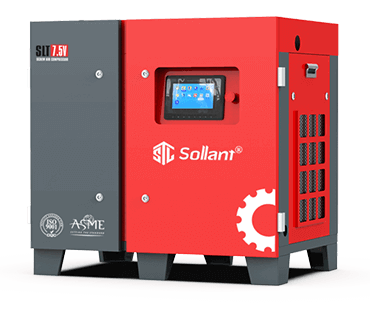
VSD screw compressor

Traditional fixed-speed compressors have fixed HP and fixed CFM. The conversion table applies. VSD screw compressors use an inverter to continuously adjust motor speed so that air output tracks demand. A 50 HP VSD screw compressor at full load produces about 220 CFM. At forty percent load, about 88 CFM, with power consumption around 22 HP. The difference shows up in the electricity bill: kW consumed per CFM at partial load is significantly lower. Annual electricity costs drop by twenty to thirty percent.

VSD compressor sizing should use the supplier's power-flow curve chart. The conversion table's applicable range ends at fixed-speed machines.

Fixed-speed screw compressors at idle (inlet valve closed, machine spinning unloaded) still consume roughly a quarter of full-load power. In scenarios with high demand fluctuation where the machine spends a large portion of the day idling, those idle-state electricity costs add up to a staggering amount over a year. VSD machines in this scenario reduce speed at low demand instead of idling. Even with a thirty to forty percent purchase price premium, in high-fluctuation scenarios the electricity savings pay back the difference in two to three years. In scenarios where demand is stable and basically at full load, a fixed-speed machine is sufficient and the VSD premium is not worth it.

Sizing Sequence

Tally up the air consumption and working pressure of every pneumatic endpoint. Determine the simultaneity factor. Add 25%-30% margin. If choosing a piston compressor, divide by duty cycle. High altitude or high temperature conditions, step up one HP tier. Long piping runs or lots of fittings, add a bit more margin. Take the final CFM number back to the conversion table and lock in the HP. Before ordering, ask the supplier for the tested performance curve (discharge pressure on the x-axis, CFM on the y-axis). This curve comes from type testing and is much more precise than any conversion table.

Specific Power

~0.3 HP
Piston per CFM
0.22-0.25
Screw HP per CFM
10 yr
TCO Comparison Window

Power consumed to produce each 1 CFM, in kW/CFM or HP/CFM. Piston compressors around 0.3 HP/CFM, screw compressors mostly 0.22-0.25, VSD screw compressors at partial load even lower. Electricity costs account for an extremely high proportion of a compressor's 10-year total cost of ownership, far exceeding the purchase price. When stuck between two machines with the same HP, compare specific power. The one with the lower number saves enough in electricity over ten years to buy a new machine.

Footer Component - SOLLANT
滚动至顶部