Our Products
Compressed Air Solutions
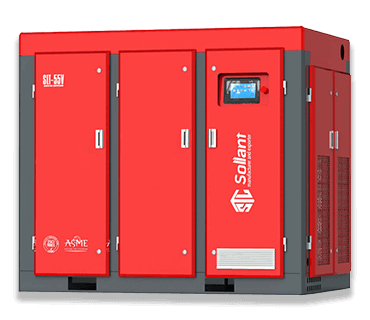
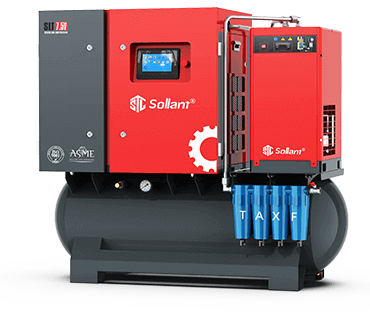
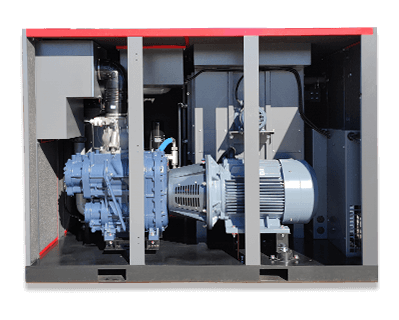
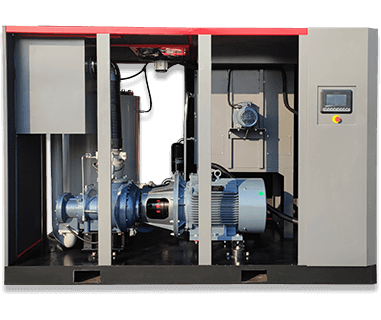
  • Screw Air Compressor
  • Oil Free Compressor
  • Diesel Portable Compressor
  • Gas Compressor
  • Specialty Compressor
  • Air Treatment
ISO 9001 Certified
24-Month Warranty
OEM & ODM Support
Factory Direct Price
All products→
Compressed Air as a Service and How the CaaS Subscription Model Works
Industrial & Energy

Compressed Air as a Service and How the CaaS Subscription Model Works

Technical Article
22 min read
Global Market

Compressed air runs at 10 to 15 percent overall energy efficiency. CaaS means a provider installs a compressed air system on the customer's site, keeps ownership, bills per cubic meter at contracted pressure and purity, handles all maintenance, and does this for ten to fifteen years. The provider makes money on the gap between the contracted rate and what electricity costs per cubic meter after optimization.

Energy is about three quarters of lifecycle cost. Hardware is under a fifth. VSD compressors, monitoring platforms like Atlas Copco's SMARTLINK and Kaeser's Sigma Network, predictive maintenance algorithms, these all exist to widen the gap between what the customer pays per cubic meter and what the electricity costs the provider to produce it.

Under customer ownership nobody tracks compressed air electricity separately. Sub-metering a compressor room costs a few thousand euros. Almost no plant installs one.

Walk into a compressor room. The discharge setpoint reads 7 bar, maybe 7.5. Walk to the production floor. Pneumatic cylinders regulated to 5. Blowoff nozzles at 4. Packaging machines at 6. One paint spray application at 6.5. The system runs a bar and a half above what anything needs. The piping between the compressor room and the far side of the plant drops about a bar through undersized runs and corroded elbows that were fine when the plant was half its current size. Nobody resized anything when the new hall went in. They ran a branch off the ring main with whatever was in stock. An operator bumped the setpoint. Then a machine starved during a shift changeover peak and someone added 0.3 bar. It's been there since. Nobody has been asked to walk the floor with a gauge and check what each application requires. It would take two days.

Each bar of excess costs about 7 percent in compression energy. That's polytropic compression thermodynamics.

CaaS providers fix this at commissioning. Pipe sections, a local booster for the spray application, setpoint down to 5.8. Every unnecessary 0.1 bar is money out of their margin.

The CaaS sales presentation spends twenty minutes on VSD and thirty seconds on pressure. VSD is brandable, photographable, proprietary. Pressure optimization is a pipe wrench. And VSD only helps at part load. A three-shift plant near capacity gets almost nothing from it. The pressure reduction saves regardless of load profile.

Here's the thing about pressure that nobody in CaaS sales wants to get into. If a customer understood that the single highest-return optimization is pipe fittings and a setpoint change, the customer might just hire a contractor and skip CaaS entirely. The CaaS narrative needs the customer to believe that optimization requires sophisticated technology and continuous expert management. Pressure doesn't fit that narrative. It's a one-time fix. Any competent pipefitter can do it. It doesn't recur. It doesn't need monitoring. It doesn't need a cloud dashboard. It doesn't need a ten-year contract.

Some Kaeser Sigma Air Utility presentations do cover pressure in reasonable detail. Atlas Copco's published efficiency guides mention it. In the sales process, though, the emphasis lands on technology and monitoring because those differentiate one provider from another. Pressure optimization is commodity knowledge.

And there's a second layer to this that's even less flattering to the CaaS model. Once the provider has done the pressure work and the VSD install and fixed the sequencing and repaired the worst leaks, the system is running near its optimum. That happens in the first year, maybe eighteen months. The remaining eight to thirteen years of the contract, the provider is maintaining and monitoring a system that's already been optimized. The ongoing optimization opportunities shrink rapidly after the initial commissioning phase. The provider's ongoing value is maintenance, monitoring, and preventing drift, all of which could be delivered through a conventional service agreement at a fraction of the CaaS premium.

The CaaS contract bundles the high-value initial optimization with a decade of lower-value ongoing management and charges a blended rate that makes it impossible to separate the two. If the pricing were transparent, customers could compare the cost of a one-time optimization project plus a service agreement against the ten-year CaaS price. CaaS providers don't structure it that way, for obvious reasons.

Provider logs the site for a week or two before signing. Baseline SEC comes back between 0.10 and 0.14 kWh/m³ for mid-range rotary screw systems. Provider knows achievable is 0.07 to 0.08. Customer has never measured SEC and has no benchmark.

Contract price reflects an equivalent of maybe 0.09 to 0.095. Customer sees savings. Provider keeps the spread.

Independent compressed air auditing exists. BPA Consulting in the UK. Various firms in Germany and the Netherlands. Compressed air consultants report fewer than one in ten CaaS customers getting an independent benchmark before negotiating. The consulting industry is small, doesn't market itself, and most procurement teams don't know it exists.

The audit also sets the demand band for the take-or-pay provision. The provider measures two weeks and extrapolates annual volume. If those weeks include a maintenance shutdown, a seasonal low, anything atypical, the baseline is wrong. The take-or-pay floor, usually 70 to 85 percent of baseline, locks in a minimum payment against that snapshot.

The people running the data loggers aren't thinking about contract terms. They're measuring airflow. The procurement people aren't in the compressor room during the audit. Two weeks in August when half the workforce is on holiday is not a representative sample. Customers should insist on logging that covers a full production cycle.

And peak demand measurement has its own problem. The provider sizes the system for peak flow observed during logging, plus a margin. If logging misses the annual peak, the system gets undersized. If it captures an anomalous spike, it gets oversized. The provider doesn't mind oversizing because it justifies a larger capital installation and a higher take-or-pay floor. Getting the measurement window right matters.

€0.022/m³ base. 40 million m³/year. Twelve years. At 2 percent annual escalation the total spend is roughly €11.9 million. At 3 percent, roughly €12.5 million. €600,000 on a single percentage point. The base price concession that consumed three meetings was probably worth less.

Between 2020 and 2022 European wholesale electricity roughly tripled. CPI moved about 18 percent. CPI-indexed CaaS contracts gave customers cheap air during that spike. Electricity-indexed ones passed the cost through. Providers offer CPI indexing because it produces a lower headline number in proposals. The provider bets electricity won't outrun CPI enough to eat the margin. That bet blew up for providers with large CPI-indexed European portfolios between 2021 and 2023. Some restructured contracts citing hardship.

CPI-indexed customers in parts of the US overpaid after natural gas prices collapsed in 2023 and 2024, dragging electricity down while CPI-indexed CaaS rates kept climbing.

CaaS brochures show a per-cubic-meter price as if it's static for twelve years. Escalation doesn't appear.

Atlas Copco's SMARTLINK and Kaeser's Sigma Network aggregate sensor data across the fleet. A provider managing 2,000 units of a compressor model builds failure prediction from vibration patterns that a two-machine site can't approach. New entrants can buy sensors and analytics. Can't buy the accumulated data.

Standard contracts give the customer a dashboard. Raw data stays with the provider. Data portability clauses need to go in at inception.

After a decade of CaaS the customer's compressed air engineering knowledge is gone. At renewal, exiting means hiring a specialist, eighteen months of rebuilding, a procurement project, and extending the current contract as a bridge on whatever terms the provider sets.

One engineer staying involved throughout the contract changes this and costs almost nothing relative to contract value.

Atlas Copco CaaS runs Atlas Copco equipment. Kaeser runs Kaeser. Published catalog data shows efficiency spreads of 5 to 8 percent between tier-one OEMs at comparable operating points in the 90 to 250 kW screw range, wider for treatment equipment.

Centrifugal installations at constant load near design point, because CaaS needs waste to monetize. Plants with in-house compressed air engineers, mostly automotive and semiconductor. Low electricity regions. Plants with uncertain futures facing decade-long take-or-pay commitments. Plants where compressed air is a tiny fraction of total energy, like a steel mill running a 200 kW compressor next to a 15 MW melting furnace, where compressed air is 1 percent of the energy bill and a 30 percent efficiency gain doesn't register.

Everything a CaaS provider does is documented in free literature from CAGI, the European Commission, and the US DOE Better Plants program. Published for twenty years. Aggregate compressed air performance hasn't moved.

Compressed air efficiency competes for engineering time against production capacity projects and loses. An internal program shows results in year one and decays by year three when the champion moves on. Atlas Copco's distributor-facing materials identify lapsed-efficiency-project customers as strong prospects.

CaaS solves the organizational attention problem. The provider's margin forces sustained optimization where the customer's org chart doesn't produce it.

Which circles back to the uncomfortable question about what the provider is selling during years three through twelve of the contract. If the major optimizations happen in year one, the ongoing value proposition is maintenance, monitoring, and drift prevention. These are legitimate services. They are also services that can be procured separately, from the same providers, under conventional service agreements, without the CaaS pricing structure, the take-or-pay exposure, or the decade-long commitment.

The reason CaaS is structured as a bundled outcome contract rather than a project-plus-service offering is that the bundled structure captures more value for the provider and makes price comparison harder for the customer. Unbundling the initial optimization from the ongoing management would give customers visibility into what each component costs, and the ongoing management component, priced separately, would look expensive relative to a standard full-service maintenance contract.

CaaS grows because it solves the attention problem and because the bundled pricing obscures the cost of solving it. Those two things are both true at the same time.

— end —
Footer Component - SOLLANT
滚动至顶部