Our Products
Compressed Air Solutions
  • Screw Air Compressor
  • Oil Free Compressor
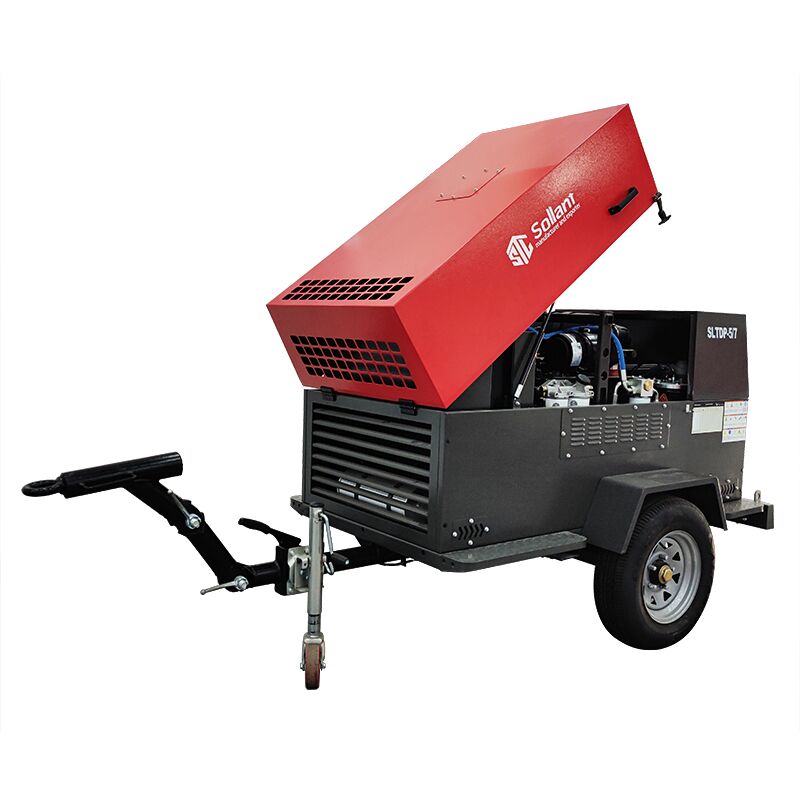
  • Diesel Portable Compressor
  • Gas Compressor
  • Specialty Compressor
  • Air Treatment
ISO 9001 Certified
24-Month Warranty
OEM & ODM Support
Factory Direct Price
All products→
Air Compressors for Rubber Manufacturing and Tire Production
Technical Guide

Air Compressors for Rubber Manufacturing and Tire Production

Technical Article
35 min read
Tire Manufacturing

The complexity of compressed air demand in rubber manufacturing and tire production exceeds the vast majority of industrial categories. Within the same factory, the mixing workshop needs high-volume rough supply, the calendering line needs pulsation-free precision supply, the curing press needs reliable dry air in high-temperature high-humidity conditions, and the tire building machine's cylinder control requires response times accurate to the millisecond. These demands coexist on a single pipe network, conflicting with and constraining each other.

Generic air compressor selection articles cannot solve tire factory problems. Screw versus centrifugal is only the starting point. How carbon black destroys an air compressor's lubrication system, how pressure pulsations leave thickness ripples on calendered rubber sheets, why there is always water in the curing workshop's pipes, why the dew point meter at the compressor station reads perfectly while solenoid valves at the curing press are seizing up in batches. These are the questions that matter.


Process Demands

What Kind of Air Each Step in the Process Needs

Mixing Stage (Banbury Mixer / Open Mill)

The Banbury mixer is driven by an electric motor. The ram raising and lowering, the drop door opening and closing, and the pneumatic conveying system all rely on compressed air. The consumption pattern is intermittent high-volume pulses: air demand spikes the instant the ram actuates, then drops to zero when the action completes. Most factories use 0.6 to 0.8 MPa supply pressure.

Ram pressure directly determines the Banbury mixer's fill factor. If air supply pressure is insufficient or response lags by half a beat, the ram cannot press the compound hard enough, carbon black and additives are not fully forced into the rubber matrix, and dispersion quality suffers. In production, this gets blamed on compound formulation or mixing parameters. Compressed air supply quality sits at the very end of the troubleshooting checklist, sometimes never making the list at all. A significant portion of mixing quality fluctuation in Banbury mixers originates at the compressor station, not at the mixer.

Calendering and Extrusion

The calender rolls rubber compound into sheets of precise thickness. The extruder forces compound through dies into strips of specific cross-section. Compressed air drives pneumatic web-guiding devices, tension control systems, cooling blow-off, and cutting mechanisms. Calendered sheet thickness tolerance is within ±0.05mm, and supply pressure fluctuation must be held within ±0.01 MPa. Among all processes, calendering has the most extreme requirement for pressure stability, bar none.

Cutting and Assembly

Ply cutting, bead winding, innerliner assembly. Precision cylinders with short strokes, fast response, high positioning accuracy. Extremely sensitive to oil and moisture. When oil mist contaminates the surface of unvulcanized rubber compound, it forms a weak interface layer during vulcanization. This defect is completely invisible in factory inspection and only shows up as ply separation after tens of thousands of kilometers on the road. Oil molecules penetrate the rubber surface microstructure, block sulfur cross-linking reactions, and permanently reduce interface strength. Deterministic physics, not a probability game.

Building Stage

A single all-steel radial tire building machine has over 200 cylinders executing hundreds of actions in strict sequence within a 40 to 60 second building cycle. Main supply pressure 0.6 to 0.8 MPa, plus a 0.1 to 0.3 MPa precision low-pressure line for bladder control.

This is where compressed air quality connects most directly and most visibly to finished tire quality. Radial Force Variation (RFV) and Lateral Force Variation (LFV) are the first checkpoint for OEM tire acceptance. RFV exceedance causes steering wheel vibration at high speed; LFV exceedance causes pull sensation. These metrics are largely determined by assembly precision during building, and cylinder action consistency is the biggest hidden variable behind that precision. When supply pressure across 200-plus cylinders fluctuates by 0.02 MPa, RFV data dispersion in the finished product increases. Many tire factories invest heavily in high-precision building machines and never question whether the air supply matches the machine's precision grade. The building machine can be accurate to hundredths of a millimeter. If the air feeding it fluctuates, that accuracy is theoretical.

Curing Stage

The curing press has the highest air and nitrogen consumption of any single process. Mold closing, opening, tire loading, unloading all on compressed air, typically 0.8 to 1.0 MPa. Curing workshop ambient temperature above 40°C year-round, relative humidity above 80%. Nitrogen curing is becoming mainstream because nitrogen's thermal conductivity uniformity beats steam, producing a more uniform temperature field. Nitrogen generation requires compressed air as feed gas, so factories adopting nitrogen curing need more total compressed air, not less. This gets underestimated during project planning with surprising regularity.


Contamination

Intake Contamination in Carbon Black Environments, and Lubricating Oil Death by Sulfur

The Banbury mixing workshop releases large amounts of carbon black dust and additive particles during feeding and mixing. Carbon black primary particles are 15 to 300 nanometers; even agglomerated, just tens of micrometers, far smaller than standard intake filter ratings. If the compressor room sits near the mixing workshop or intake ducting design pulls in workshop air, trouble follows.

Carbon black enters an oil-injected screw compressor and dissolves into the lubricating oil. Viscosity characteristics change. Antioxidant performance degrades. The oil separator clogs faster. On the oil cooler's heat exchanger tube walls, carbon black builds up a deposit layer with terrible thermal conductivity, like wrapping the cooler in a blanket. Discharge temperature climbs. High-temperature shutdown protection starts triggering. The factory's troubleshooting sequence is predictable: replace the temperature sensor, clean the cooler, investigate cooling water quality, wonder if the ambient temperature got hotter this summer. Months pass. Eventually someone thinks to check the intake. For oil-free screw compressors the failure mode is different: carbon black attacks the rotor coating, and once that coating delaminates, the repair bill is roughly a third of what the whole machine cost.

Countermeasures: position the compressor station upwind of the mixing workshop; intake at the highest building point with weather louvers and multi-stage pre-filtration; positive-pressure intake ducting, not negative-pressure suction; self-cleaning filtration ahead of the compressor, below 1 micrometer. Some factories put continuous particulate monitors on the intake with automatic switchover to backup ducting.

Of all these, compressor station siting and intake orientation are locked in at the earliest project phase. Once the building goes up, these cannot change. And here is where the tire industry has a persistent organizational problem. The entity doing the design at this phase is typically the utility engineering discipline at the design institute or EPC contractor. Competent people, well-versed in general codes, limited exposure to what carbon black actually does inside a compressor. The maintenance engineers who know about this are either not yet hired at the design stage or not invited to design reviews. Commissioning happens, the intake problem surfaces, civil works and piping are fixed in place, and the only option is retrofit filtration at double the cost and reduced effectiveness.

This is not a technical problem. Compressor station design falls under auxiliary utilities in a factory construction project. It ranks low on the priority list. Main process equipment selection discussions run for months. Compressor station review gets one meeting, maybe two, and the people in the room have limited tire factory operating experience. The subsystem most likely to cause operational headaches receives the least design-phase attention. This keeps happening across the industry, project after project.

On top of carbon black there is sulfur. Rubber mixing uses large quantities of sulfur-containing additives. Mixing and curing release low concentrations of hydrogen sulfide and sulfur dioxide into the workshop air. Below occupational health limits, not an acute hazard to people, and the damage it does to oil-injected screw compressor lubrication happens slowly enough that the cause-and-effect link is hard to see without looking for it.

Sulfur compounds dissolve into lubricating oil and react with copper ions (from bearings and cooler copper components) to generate copper sulfide micro-precipitates. Standard oil filters cannot catch these. They form a hard film on bearing surfaces and seals. Sulfur compounds also accelerate hydrolysis of ester-based synthetic lubricating oils, producing corrosive organic acids. Equipment engineers who run the same compressor brand in a tire factory and in, say, a bottling plant, notice that the tire factory machine consistently shows worse oil analysis numbers despite identical maintenance schedules. The sulfur is the explanation, though it takes a while to figure that out.

Shorten oil change intervals to 60% to 70% of the manufacturer's recommendation. Select PAO-based synthetic oil instead of ester-based, because PAO resists sulfur compounds far better. Install online oil condition sensors and change oil based on acid number and particle count data, not the calendar. Compressor manufacturers write their maintenance manuals for generic conditions. A tire factory is not generic conditions.

Sulfur-containing gases also corrode the copper components inside the compressor. Oil cooler and aftercooler copper tubes and fins undergo dezincification in sulfur-containing air, walls thinning until perforation. Cooling water leaking into the oil circuit or air circuit is catastrophic. Some compressor manufacturers now offer stainless steel heat exchanger options for tire industry projects, at roughly 15% to 20% cost premium. This money should be spent.


Precision

Pressure Pulsation and Calendering

Compressed air output is inherently periodic. Screw compressors have spiral discharge pulsation, centrifugal compressors have impeller-related fluctuation. After attenuation through receiver tanks and the pipe network, normally controllable. Calendering line pneumatic web-guiding systems are extremely sensitive.

A 0.02 MPa pressure fluctuation translates to a few dozen newtons of cylinder thrust difference. On a web-guiding roller running at speed, this produces periodic lateral displacement of the rubber sheet and regular thickness non-uniformity patterns. Production engineering encounters "calendered sheet thickness fluctuation" and checks roller gap control parameters first. Then the hydraulic system. Then the web-guiding sensor. Compressed air comes last in the troubleshooting order, if it comes up at all.

What makes this particularly maddening is that pulsation-induced thickness fluctuation and roller-gap-induced thickness fluctuation look identical on the sheet. The only way to tell them apart is frequency spectrum analysis: compare the period of thickness variation against the compressor discharge pulsation frequency. Match means the air did it. Without that analysis, factories can spend weeks chasing the wrong root cause.

Independent surge tank on the calendering line supply branch, two-stage stabilization with precision regulator valve sets, accumulator stabilizers ahead of pneumatic components. Damping tank volume needs calculation against pipe length, supply pressure, and consumption pulse frequency. Not a case where bigger is automatically better.


Moisture

The Curing Workshop Moisture Problem

Curing workshop: 40 to 55°C ambient, above 80% humidity, steam everywhere. Compressor station outlet pressure dew point -40°C. Steady-state, the air traveling through long pipe runs to the curing workshop stays dry. The problem is not steady-state.

When curing presses stop or production drops, air sitting in the pipes equilibrates with the 40°C-plus ambient. When the line restarts, dry air from the compressor station rushes into those hot pipes. Trace moisture on pipe walls gets flushed into pneumatic components. Every stop-start cycle is a condensation pulse. Curing workshops cycle between running and idle states constantly per production schedule. The total moisture entering the pneumatic system through these transients adds up to far more than most people would guess.

Carbon steel pipe in the curing workshop corrodes fast. The steam and sulfur in that environment are aggressive. Iron rust flakes jam solenoid valves, abrade cylinder seals, block orifices. Cumulative damage: starts as a few dozen milliseconds of valve response delay, imperceptible, gradually worsens to mold synchronization failure or bladder inflation delay. Under-cured tires or cosmetic defects result.

Curing workshop piping should be stainless steel or aluminum alloy. Aluminum alloy is the recommendation, without hesitation. Carbon steel average service life in the curing workshop is less than a third of aluminum alloy, and downtime losses dwarf the material cost difference. Regional secondary drying station at the workshop entrance. Three-stage end-point filters ahead of critical curing presses. Pipe slope and drain point placement need extra attention.

On dew point monitoring: most tire factories put the dew point meter at the compressor station outlet. That number is always -40°C. If an online dew point meter goes in at the end-use point in the curing workshop, the reading is completely different. Leaks in the long pipe network (flanges, valve packing) let ambient moisture infiltrate back in. Combined with transient condensation, end-point dew point can be 30 to 40°C higher than the station outlet. The dryer is fine. The air arriving at the equipment is not. End-point dew point monitoring costs very little and solves this visibility problem immediately. Almost nobody does it.


Flow Dynamics

Dynamic Flow Surges at Building Machines

Building machine, 40 to 60 second cycle, 200-plus cylinders actuating in dense sequence, peak flow 5 to 8 times steady-state average. When this pulse hits the supply main, other building machines on the same branch lose pressure instantaneously.

Tiered energy storage handles this. Medium receiver tank on the main line for overall stabilization, 0.3 to 0.5 m³ small receiver tanks beside each building machine for peak pulse absorption, connected through appropriately sized piping. Pipe diameter and length between tank and machine are just as important as tank size. Too narrow or too long, and flow resistance cancels the buffer. Equivalent pipe length from buffer tank to building machine main air connection should not exceed 5 meters, pipe inner diameter not less than the machine's main port diameter. Straightforward engineering on this one.


Equipment Selection

Compressor Type Selection

Tire factory compressor stations use screw or centrifugal as primary units.

Centrifugal compressors show up more and more in large tire factories. Above 100 m³/min total plant consumption, centrifugal efficiency advantage becomes meaningful. Inherently oil-free. Specific power near rated conditions beats equivalent screw machines. Poor at handling flow variation. Surge boundary sets a floor on minimum flow, and tire factories have large swings in air demand between shifts and during mold changes. Large plants typically run centrifugal for base load with variable speed screw compressors for peak shaving.

Coordinating the control logic of two compressor types running in parallel is where this gets complicated. The centrifugal must stay above surge. The screw must avoid frequent loading and unloading. Their response time constants are different by a large factor. If the central controller's algorithm is not well-tuned, the two machines oscillate against each other, fighting for load, and system efficiency drops below what a single machine type would have delivered.

The centrifugal efficiency curve is steep. High efficiency between roughly 85% and 105% of rated flow, sharp falloff outside that band. Selection-phase comparisons look at specific power at rated point. After commissioning, the actual operating distribution may sit well outside that sweet spot. Some factories pay double the screw solution cost for centrifugal units and get no better full-year weighted average specific power than variable speed screw would have given them. The consumption curve did not match the machine's efficient operating range.

There is a commercial dimension to this that buyers should be aware of. Centrifugal unit price runs 2 to 3 times equivalent screw machines. Sales margins are higher. Aftermarket service contracts are larger. Whether that incentive colors the objectivity of technical recommendations during the proposal process is something each buyer has to evaluate for themselves. One concrete test: if the party recommending centrifugal cannot produce hour-by-hour efficiency comparison data mapped against the buyer's specific air demand load curve, and instead only compares rated-point specific power, discount that recommendation. Before selecting, monitor factory air consumption continuously for at least two weeks (for greenfield plants, get measured data from a similar operating factory), plot the full demand curve, and overlay it on each candidate machine's efficiency map. The investment in monitoring is trivial compared to the cost of a mismatched compressor fleet.

Oil-injected screw compressors remain the workhorse for small and medium tire factories. Mature technology, well-established service infrastructure, handles load swings well. Post-treatment configuration and maintenance discipline are what make or break the outcome. Residual oil below 0.01 ppm is the baseline for building and assembly processes. Total ownership cost for oil-injected screw plus high-grade post-treatment in medium-scale factories runs lower than equivalent oil-free screw, provided post-treatment maintenance is done properly.

Oil-free screw and oil-free scroll have limited tire industry application: inspection equipment, labs, special compound processes. Choosing between oil-free and oil-injected is not a technical decision. It is an honest assessment of maintenance management capability. Strong maintenance discipline makes oil-injected plus post-treatment more economical. Inconsistent maintenance makes oil-free safer. For most tire factories, oil-injected screw with high-quality post-treatment remains the optimal configuration. The equipment cost savings versus oil-free should go into building a more rigorous post-treatment maintenance program and periodic compressed air quality testing.


Air Quality

Post-Treatment

Post-treatment determines final compressed air quality more than the compressor does.

First stage: aftercooler (air-cooled or water-cooled), discharge temperature down to ambient plus 10 to 15°C, most moisture condenses out. Second stage: water separator strips liquid water, main filter set removes particulates above 3 micrometers and most liquid oil. Third stage: dryer. Refrigerated dryers reach about +3°C pressure dew point, not adequate for curing workshop long pipe runs. Tire factory main headers get adsorption dryers, pressure dew point -20°C to -40°C. Regeneration air consumption matters: heatless type around 15%, micro-heat 7% to 8%, blower-heated 2% to 3%. Large plants are moving to heat-of-compression regeneration dryers that use the compressor's 150 to 200°C discharge heat to regenerate molecular sieve, consuming near-zero finished air. When paired with centrifugal or oil-free screw machines, heat-of-compression dryers are the clear best choice. Fourth stage: precision filters, particles above 0.01 micrometers and residual oil below 0.003 ppm. Fifth stage: activated carbon oil-removal filters at point of use for building and assembly.

Operationally, filters not replaced on schedule cause excessive pressure drop. A clogged element costs 0.03 to 0.05 MPa of parasitic loss, 3% to 4% of compression energy wasted. Molecular sieve pulverization in adsorption dryers is a subtler failure mode: fine particles of extremely hard material leak downstream and abrade pneumatic components worse than rust does. No alarm triggers when this happens. Only periodic compressed air quality testing catches it.

Almost every tire factory specifies ISO 8573-1 quality classes during procurement. Solid particles Class 1, moisture Class 2 to 4, oil content Class 1. After commissioning, almost nobody conducts the periodic third-party testing that ISO 8573 itself requires. Quality monitoring shrinks to glancing at the dryer panel dew point and the filter differential pressure gauge. Oil content testing requires dedicated sampling equipment and analytical methods. The vast majority of factories never do it. The standard gets written into the procurement contract and then ignored as an operational requirement. It decorates documents.


Economics

Energy Efficiency

Compressed air systems typically account for 15% to 25% of tire factory total electricity consumption.

Leakage is worse in tire factories than in most industries. Rubber dust and particles embed in pipe joint sealing surfaces, aging seal rings faster. A factory with average management can leak 25% to 35% of its compressed air. Ultrasonic leak detection, the standard tool, is harder to use when background noise from Banbury mixers and calenders sits above 85 dB. A single leak detection and repair campaign achieves good results that evaporate within 6 to 12 months unless periodic inspection and accountability mechanisms are established.

Open blow-off nozzles across the factory are another hemorrhage. Scrap clearing, conveyor cleaning, sheet cooling, all done with wide-open nozzles. A 6mm bore nozzle at 0.6 MPa burns through about 400 liters per minute. A few dozen of those across the plant equal the entire output of a 37kW compressor, doing nothing but blowing air. Venturi air-saving nozzles cut consumption by 60% to 80% at negligible cost. Getting operators to switch is the hard part. The cheapest improvements meet the most resistance because they require changing habits, not writing purchase orders.

Pressure zoning. Many tire factories run a single 0.8 MPa network plant-wide. Building machines that need 0.6 MPa pay the energy penalty of being fed at 0.8 MPa then reducing down. A dual-pressure network (0.8 to 1.0 MPa for curing, 0.5 to 0.6 MPa for building and cutting) saves 10% to 15% on the compressed air system. Each 0.1 MPa supply pressure reduction cuts specific power by roughly 6% to 8%.

Concrete numbers: a 250kW compressor dropping supply from 0.8 to 0.7 MPa saves roughly 120,000 to 150,000 kWh per year. A large tire factory compressor station at 2,000 to 3,000kW total, with discharge pressure set 0.1 MPa too high across the board, burns an extra 600,000 to 1,000,000 RMB per year in electricity. The cause is often just the operator raising the setpoint for comfort margin, or the pipe network losing so much pressure to leaks and friction that the station has to compensate by pumping harder. Fixing leaks and optimizing piping is the correct response. Raising source pressure is the easiest response and the most expensive one.

Heat recovery. Air compressors turn 80% to 90% of input electricity into heat. Tire factories can use that heat: compound preheating in the mixing workshop, Banbury mixer cooling water temperature maintenance, winter building heating. A heat recovery system captures 70 to 90°C hot water from the compressor cooling circuit and feeds it into the process heat network. In northern China, a 250kW compressor's heat recovery replaces an equivalent electric boiler during heating season. Payback is short and the technology is proven. Not much more to say about it.


Infrastructure

Pipe Network

Main loop header diameter must account for mass curing press startup surges. Dozens to over a hundred curing presses starting together produce instantaneous air demand several times normal. Pipeline capacity between any two adjacent supply entry points on the loop should be no less than 150% of that section's peak demand.

Branch pipe slope matters more in high-temperature workshops. No less than 1:100 toward drain points. Thermal expansion in the curing workshop shifts the slope set during installation; supports need expansion allowance. Drain point spacing down from the standard 30 to 50 meters to 15 to 20 meters. Drain valves: float-type sticks in condensate contaminated with rubber dust; electronic timer-type may allow too much condensate accumulation between drains; combined timer-and-level control type performs best in tire factory conditions.

Pipe material. Carbon steel corrodes fast in the wet, sulfur-containing tire factory environment. Aluminum alloy has higher initial cost and lower lifecycle cost. Smooth inner wall means roughly 30% less frictional pressure drop at the same diameter compared to carbon steel, which translates into the ability to lower discharge pressure settings, which translates directly into energy savings. Quick-connect aluminum alloy pipe systems are gaining ground fast in new tire factory construction.

Branch pipes in tire factory workshops hang on racks below the roof truss, sharing space with cable trays and process water pipes. In the curing workshop, roof exhaust skylights sit above these pipes. Rainy season skylight leakage drips on the pipe exterior. Carbon steel with damaged or missing insulation corrodes from outside in faster than anyone expects. Perforation means not just air leakage but external moisture and contaminants entering the air circuit.


Automation

Controls

Modern compressor station central controls schedule start/stop and load/unload based on real-time consumption, network pressure, and unit status. Advanced systems connect to MES and predict demand from the production schedule. Curing press mold cycles range from ten-plus to several tens of minutes, each open/close being a demand pulse. MES tells the controller that 20 presses open molds in 5 minutes, the controller pre-starts standby units or ramps the VSD machine. Good concept.

Almost nobody has actually implemented it. The vast majority of tire factory compressor stations run on simple pressure-band logic. MES integration is rare, not because the technology is unworkable but because the compressor station and production control sit under different departments. Getting the data interface built requires cross-departmental coordination, which in most organizations is harder than any engineering problem.

And the more basic issue: before investing in predictive scheduling software, getting baseline parameters right pays more. A discharge pressure setpoint 0.1 MPa too high wastes more energy than an advanced control system can save. Operators raising setpoints by 0.1 to 0.2 MPa for comfort margin is universal, and the extra electricity cost per year across a large compressor station is enormous. Until the basics are handled, layering intelligence on top produces marginal returns at best.


Summary

Conclusion

A tire factory's compressed air system succeeds or fails based on depth of understanding of process requirements, post-treatment system configuration and maintenance, pipe network design precision, and sustained investment in operation and maintenance. Factories that get all these elements right can achieve compressed air costs 30% or more below industry peers, with pneumatic fault rates an order of magnitude lower. The difference is not in how expensive the equipment is, but in how deep the understanding runs and how rigorous the execution. The compressed air system level of a tire factory can be read at a glance from the pipe material and drain valve condition at the curing workshop endpoint.

— END —
Footer Component - SOLLANT
滚动至顶部