Our Products
Compressed Air Solutions
  • Screw Air Compressor
  • Oil Free Compressor
  • Diesel Portable Compressor
  • Gas Compressor
  • Specialty Compressor
  • Air Treatment
ISO 9001 Certified
24-Month Warranty
OEM & ODM Support
Factory Direct Price
All products→
What's the Difference Between a Permanent Magnet VSD Compressor and a Regular VSD Compressor
Technical Guide

Permanent Magnet VSD Compressor vs. Regular VSD Compressor

Technical Article
35 min read
VSD Compressor

Permanent magnet VSD uses a permanent magnet synchronous motor (PMSM), regular VSD uses a three-phase asynchronous induction motor plus an inverter. The motors are different, and a whole string of things after that are all different.

The Electricity Thing

The first question most people care about is how much electricity they save.

37kW unit, actual measurement: permanent magnet VSD full load draws 32kW·h, unloaded 3 to 3.5kW·h, can sleep down to near zero. Same-power belt-driven fixed-speed machine full load 35kW·h, unloaded and idling still pulls 18kW·h. Full load only 3kW·h apart, unloaded 15kW·h apart. Air compressors spend 30% to 50% of the day unloaded or at partial load, and that's where the electricity savings come from. 100kW unit running 7,500 hours a year, electricity at $0.085/kWh, annual electricity cost around $64,000, at a 33.7% savings rate that's about $21,500 saved per year. One cement plant swapped five 110kW fixed-speed units for five 90kW permanent magnet VSD, saved 104kW·h per hour, over $99,000 a year.

These numbers are all worked out under specific conditions. Swap in a different set of conditions, completely different results. Electricity prices vary a lot by region. Industrial power has peak and off-peak tiers, peak can be three times off-peak. If the compressor's main unloaded periods happen to land in off-peak hours (say a factory with low nighttime production), the kilowatt-hours saved during unloaded operation don't change, but convert that to money and it shrinks a lot. Flip it around, if unloaded time lands in peak hours, the money saved is more than what you'd get calculating with average rates. Doing energy savings math you can't just take average price times total kilowatt-hours, you need to calculate by time-of-use rates period by period to get it right.

There are a few preconditions that sales won't really bring up on their own.

That 30% to 50% savings rate is compared against fixed-speed machines. Between permanent magnet VSD and regular VSD the gap is roughly 10% to 15%. At full load the efficiency difference between the two types of VSD is only 3 to 5 percentage points. The gap opens up after the load comes down, at 50% load the asynchronous motor's efficiency drops to 75% to 85%, the permanent magnet motor is still above 90%. At 25% load the regular VSD is basically past its speed regulation range and can only idle, while the permanent magnet VSD can still run at low speed.

And another thing: the inverter itself eats 2% to 3% of the power. Full-pressure full-load continuous running (24-hour production chemical plant), a VSD compressor's power consumption might actually be higher than a fixed-speed machine. In that scenario going permanent magnet VSD is spending more money for nothing.

The "save 30% to 50%" in the marketing materials has another chunk mixed in there: the benefit from pressure precision. Fixed-speed machines have big pressure swings, to deliver 6 bar at the point of use the supply side has to be set at 8 bar to leave margin, every extra 1 bar costs roughly 7% more energy. Permanent magnet VSD holds discharge pressure within ±0.01 MPa, regular VSD ±0.02 to 0.05 MPa, fixed-speed machines ±0.1 to 0.2 MPa. That alone saves an additional 10% to 14% in energy consumption, a completely separate thing from the motor efficiency difference. For processes sensitive to pressure fluctuation like injection molding and electronics packaging, the gap between ±0.01 MPa and ±0.05 MPa isn't just about saving electricity, it directly hits product yield. Injection molding clamping force is directly tied to air pressure, pressure fluctuates too much and product dimensional consistency goes bad, reject rate goes up and the electricity savings don't even cover the scrap cost. In electronics packaging unstable pressure causes uneven adhesive dispensing, component placement shift, rework costs far exceed those few kilowatt-hours. These downstream process-level benefits rarely get written into compressor selection comparisons, because they're too complicated to quantify.

GB 19153-2019 came up with a weighted energy efficiency method for variable-speed compressors, assigning weights of 25%, 50%, and 25% to full load, 70% flow, and 40% flow respectively. The standard has a line in it: "To meet the 40% volume flow energy efficiency indicator, a permanent magnet synchronous motor or motor of equivalent performance is required." The vast majority of manufacturers still only use full-load specific power for promotion when selling, weighted energy efficiency basically doesn't get mentioned. The air conditioning industry is way ahead on this, half-load weight is 46.1%, full-load weight is only 2.3%.

Figuring out whether permanent magnet VSD is right for your factory, the more reliable way is to install a flow meter and pressure sensor at the discharge port and record data for a week or two. If the curve looks like a sawtooth jumping up and down, permanent magnet VSD has big room for savings. If the curve is basically a flat line, regular VSD or even fixed-speed might be more cost-effective.

Lots of manufacturers' salespeople will come to your site to do a "free energy audit," the report conclusion almost always points to "recommend switching to permanent magnet VSD." The evaluator and the seller are the same company, take the conclusion with a grain of salt. If conditions allow, getting an independent third-party testing organization to do the assessment is more reliable.

How much does the air compressor's electricity bill actually weigh in your total plant electricity costs? If monthly power bill is $69,000 and the compressor station accounts for $20,700, saving 30% is $6,200 a month, that number is worth seriously studying your selection options. If monthly power bill is $69,000 and the compressor station only accounts for $2,750, saving 30% is $825, spending a lot of effort doing assessment doing retrofit doing acceptance, the return on investment isn't necessarily worth it, maybe the same effort spent optimizing other equipment yields bigger returns. Air compressor energy-saving retrofits have been hyped up hard these past few years. Government subsidies, energy service company profit-sharing models, financing leases, all sorts of driving forces stacked together, sometimes it makes people feel like not switching to permanent magnet VSD means losing out. Take a calm look at your own electricity structure before deciding.

Most small and medium factories have never once measured their air consumption patterns, compressor gets installed and runs, the numbers on the operation log are often guessed. Not being able to say how many cubic meters of air they use per day is extremely common. If you can't install a flow meter, at least look at the cumulative loaded time and cumulative run time on the compressor's control panel, the ratio of those two is a rough estimate of average load factor. Ratio staying below 60% long-term means the compressor is spending a lot of time idling, VSD retrofit has big payoff potential. Ratio above 85% means load is stable near full capacity, VSD retrofit benefits are limited.

Whether the Energy Savings Numbers Themselves Are Trustworthy

Air volume inflation has always been a thing in the compressor industry. Different manufacturers use different "free air" reference conditions when marking discharge volume, temperature, pressure, humidity values are all different, same machine same actual output can differ by over 20% on paper. "Normal conditions" 0°C plus 760mmHg corresponds to volume index 1.00, "standard conditions" 20°C plus 1 bar corresponds to about 1.05, "working conditions" 35°C plus 14.4 psi plus 60% relative humidity corresponds to about 1.20. There are even cruder tricks: directly inflating the motor service factor, a 110kW machine labeled as 90kW, a 20 cubic meter output gets 16.1 cubic meters printed on the nameplate. GB 19153-2019 added a clause: measured input power of the unit shall be less than the value of the next higher rating above the drive motor's rated power, a 90kW motor must not exceed 110kW.

2020 spot-check failure rate for air compressors was 22.4%. Motor authority spot-checks found roughly 50% of permanent magnet motors failed to meet IE3 efficiency standard for asynchronous motors.

Type test reports and commissioned test reports are two different things. Type testing is done once at product certification, testing the submitted sample. Commissioned testing pulls randomly from shipped products. Some manufacturers use the same type test report for years, during which time the supplier changed, the magnet grade was downgraded, the winding process was altered, the numbers on the report stopped representing the current product long ago. What you want to see is a commissioned test report issued by an independent third party within the last 6 months.

Motor Principles

Permanent magnet synchronous motor

Permanent magnet synchronous motor has NdFeB rare earth permanent magnets on the rotor, once magnetized they establish the magnetic field on their own, don't need continuous external energy input. The stator gets variable-frequency AC to produce a rotating magnetic field, rotor follows in sync, zero slip, no induced current on the rotor so no rotor copper loss. Won't go into the asynchronous motor principle here, the short version is it drives a squirrel-cage rotor through electromagnetic induction, rotor speed has to be slower than synchronous speed for it to work, full-load slip 1% to 5%, rotor copper loss accounts for 20% to 30% of total losses, and it pulls large amounts of reactive current from the grid to establish the magnetic field resulting in a power factor of only 0.75 to 0.85. Permanent magnet synchronous motor power factor approaches 1.0.

The efficiency advantage of the permanent magnet motor comes from a very simple thing: the magnetic field is from the permanent magnets, doesn't cost the grid any electricity, doesn't change with speed. The asynchronous motor is designed around its rated operating point, efficiency is highest at that point, once the inverter shifts the frequency efficiency drops. Below 10Hz flux distribution is already severely distorted, V/F compensation curves are basically useless, the iron loss to copper loss ratio is a completely different story from rated conditions. An air compressor's load jumping back and forth from full capacity to 20% within a single day is normal, permanent magnet motor magnetic field strength doesn't change at any speed, efficiency curve is flat, under this kind of operating condition the advantage is big.

Permanent magnet synchronous motor is picky about its inverter. Must be paired with a dedicated vector control inverter with precise rotor position detection, once it loses sync it stops dead and might even damage the windings. Vector inverters cost 1.5 to 2 times more than scalar ones (37kW range), some OEMs cut costs by forcing a scalar inverter onto a permanent magnet motor. Near full load you can't tell, drop the speed below 30% and it shakes. Current waveform distortion, heating increases, efficiency might actually be worse than a regular VSD with a good inverter driving an asynchronous motor. How to spot it: whether the inverter nameplate lists "PMSM" control mode, whether there's a resolver or encoder at the motor shaft end. Neither present, you can basically conclude the control method has problems.

Demagnetization

Writing this section long, because demagnetization is the most serious in consequences among all problems with permanent magnet VSD compressors, and it's where the reliability gap with regular VSD compressors is widest.

NdFeB permanent magnet material, magnetism fades as temperature goes up, thermal motion of magnetic domains intensifies causing more and more domains to deviate from their original alignment, magnetic field weakens. Temperature comes back down, the deviated domains don't all return to position, the loss is locked in. 38UH grade magnet data: about 2% loss at 80°C (176°F), about 5% at 100°C (212°F), about 7% at 120°C (248°F), about 12% at 150°C (302°F).

Integrated permanent magnet compressor, motor and screw airend share the same shaft, airend oil temp 65 to 80°C transfers directly to the rotor through the shaft. When cooling conditions aren't good the working temperature can get pushed way past the design value. After magnetism fades the motor draws more current to maintain output, more current raises winding temperature, higher temperature causes magnetism to fade further. Once that degradation loop starts it can't be stopped, current keeps climbing until the inverter trips on overcurrent, and the permanent magnet motor can only be replaced as a whole unit.

The cost of replacing the motor isn't just the motor itself. Tearing out the old one and putting in the new one means shutdown, and shutdown means production stops. If there's no backup unit during the overhaul, all downstream air-consuming equipment goes down. Some factories have their main product lines running off just one or two compressors, one day of downtime can cost several times the motor's price.

The tricky thing about demagnetization is there are almost no early warning signs. Motor current creeps up slowly, the inverter compensates automatically, discharge pressure and volume look perfectly normal for a long time. If maintenance staff don't periodically compare nameplate current against running current they simply won't notice the problem building up. By the time the inverter reports overcurrent and discharge volume drops hard, it's already too late.

If the compressor station has an energy monitoring system and someone actually looks at the data regularly, the abnormal current trend can be caught early. Most small and medium factories don't have that system.

There's a way to check for demagnetization: disconnect the airend from the motor, run unloaded to rated frequency, measure the motor output voltage. Output voltage more than 50V below nameplate back-EMF, demagnetization is basically confirmed. This requires shutdown, taking apart the coupling, reconnecting wiring, not something you can do during routine inspection rounds.

The industry's default design target is less than 3% magnetic loss over 15 years. Domestic NdFeB material lifespan data under long-term high-temperature operating conditions is still not sufficient to this day. The oilfield and textile machinery industries used permanent magnet motors before the compressor industry, and they've piled up a fair number of magnet failure and scrappage cases. The compressor industry went permanent magnet later, long-cycle data is nowhere near enough. Whether the 15-year 3% target can be delivered, only time will answer.

After a motor loses magnetism the whole thing has to be pulled out and shipped back to the factory. Factory tears it open, tests to confirm the magnet issue, then decides whether to re-magnetize or replace magnets. Re-magnetization needs specialized equipment, not every factory has the capability. Replacing magnets is basically rebuilding the rotor. From sending it in to getting it back, minimum two to three weeks, could be one to two months, during which time the compressor station either runs on a backup unit or cuts production. Small and medium factories with only one or two compressors, downtime losses can exceed the value of the motor itself.

After-sales disputes from demagnetization are also very common. User says it's a quality issue, wants warranty. Manufacturer says the operating environment exceeded specs or the user messed with inverter parameters. Whether it's the material not handling temperature well enough or a cooling design problem or operating conditions beyond design range, that needs a professional institution to determine, long timeline, expensive, small and medium users can't afford to go through it. Most of the time the user pays for a new motor out of pocket.

There's a situation even more of a headache than demagnetization itself: slow demagnetization causing hidden efficiency decline. The motor hasn't fully lost its magnetism, still runs normally, inverter hasn't alarmed, discharge volume hasn't obviously dropped, but the current is 10% to 15% higher than when it left the factory. Maintenance staff won't notice this level of change, the extra money on the electricity bill gets buried in rate fluctuations and production volume changes. Three to five years later someone does a system energy efficiency audit and discovers this machine's specific power has drifted way off its nameplate value, and can't be recovered. The cumulative economic loss from this boiling-frog style demagnetization can be bigger than sudden total loss of magnetism, because it lasts longer and gets discovered later.

Electrical demagnetization, vibration demagnetization, oxidation demagnetization also need guarding against. High-current surges and short-circuit faults produce reverse magnetic fields that wreck the magnets. Long-term vibration throws magnetic domains into disorder. Humid environments, magnet surfaces oxidize. Integrated units typically IP23 protection, objects over 12mm diameter can get in, dusty environments iron particles get sucked onto the rotor by the magnets, heat dissipation and wear both get worse at the same time.

The reliability advantage of asynchronous motors gets very obvious once you change the environment. Typically IP54 or IP55 fully enclosed construction, runs tens of thousands of hours in dusty, humid, salt-spray environments without needing attention. Not afraid of temperature swings, not bothered by dust getting attracted to the rotor, demagnetization simply doesn't exist as a problem. Main failure mode is bearing wear, proper lubrication gets you 30,000 to 50,000 hours bearing life, changing bearings takes half a day to one day, a set of bearings costs a few hundred dollars, on a completely different level from replacing an entire permanent magnet motor. This reliability gap isn't very noticeable in a dry clean machine room, move to a cement plant, a mine, a coastal chemical plant and it becomes the deciding factor. Quite a few factories that got burned by permanent magnet motor demagnetization in harsh environments, when purchasing later they'd rather give up the permanent magnet energy savings and pick asynchronous VSD instead, taught their lesson by after-sales headaches and downtime losses.

Magnet Supply Chain

Rare earth elements account for about 30% of permanent magnet material cost, high-temperature demagnetization resistance requires dysprosium and terbium, both expensive and supply-demand is tight. UH-grade magnets rated for 150°C, dysprosium 0.5% to 5%, terbium 0.5% to 2%. Praseodymium-neodymium oxide price doubling in a short period is not uncommon. When rare earth prices spike, small and mid-size motor manufacturers' margins might shrink to 5% or even go negative, most direct move is to make the magnets thinner or drop the grade one level. Magnets thinner, demagnetization resistance takes a hit, grade lower, temperature ceiling drops. There's a documented case where the design specified 180°C grade but what got installed was 155°C grade, initial test parameters looked fine, after thermal stabilization performance kept deteriorating, end result was current surging and inverter tripping with complete loss of magnetism. Buyers can barely tell the difference through routine acceptance. Asking the equipment supplier for the magnet supplier's factory inspection report with grade and batch number marked on it is reasonable. If the supplier can't produce it, that fact alone tells you something.

Integrated Units and Separate Units

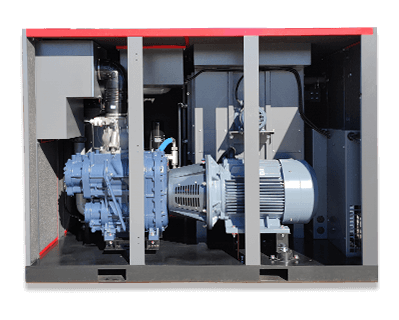
Integrated unit, motor rotor mounted directly on the screw airend's extended male rotor shaft, coupling and gearbox eliminated, transmission efficiency theoretically highest, the price is the motor eats the airend's oil temperature. Separate unit adds a coupling, 1% to 2% transmission loss, but the motor has independent cooling and runs at much lower temperature. Internal industry test data: integrated unit at 120°C (248°F) copper losses about 25.1% higher than separate unit at 80°C (176°F), works out to roughly 3.5 percentage points lower operating efficiency. Won't find that in the manual. Below 132kW integrated is still manageable, above 160kW separate with independent cooling fan is recommended.

Disassembly and maintenance on integrated units is also a pain. Have to pull the motor before you can service the airend, the permanent magnet rotor's magnets strongly attract ferrous tools, clumsy handling can send parts flying and hurt someone, debris can also stick to the magnets causing secondary damage. Non-magnetic specialized tools and fixtures required, trained people to operate. Smaller cities and remote areas, finding this kind of maintenance crew isn't easy, response time can stretch from hours to days. Separate units, airend and motor each mind their own business, anyone with screw compressor repair experience can handle it. This difference almost never gets discussed during procurement review, because everyone's attention is all on energy efficiency numbers and price, it's only felt for real when the first major overhaul comes around two years later.

Asynchronous motor stator-rotor air gap has to be controlled within 0.5 to 1mm, otherwise efficiency deteriorates, factory inspection is strict. Permanent magnet motor air gap can be made bigger, assembly tolerances more relaxed, lower vibration and noise. But bigger gap tolerance also means some manufacturers can loosen tolerance control and short-term testing won't show it, it comes out during long-term operation as increased vibration and premature bearing wear.

This quality control difference is basically invisible during bidding. The technical specs in the bid documents all look about the same, price becomes the only differentiator. After a low-price bid wins, whether the delivered product is at the same level as the bid sample, very few buyers have the ability or willingness to verify. By the time problems come out the warranty period might already be over.

Cost and Selection

Purchase price gap 15% to 30%. In total lifecycle cost procurement is only 25% and energy is 75%, payback period typically 1 to 2 years. 37kW unit running 4,000 hours a year, permanent magnet VSD annual electricity cost around $9,000, regular fixed-speed around $14,700, $5,700 saved per year.

Grid connection costs often get left out. A 37kW permanent magnet motor operating current about 48A, same power asynchronous fixed-speed 68 to 75A. Building a new compressor station or expanding electrical capacity, the transformer cables switchgear can all be sized one tier lower, the money saved sometimes directly covers the equipment price gap. If the factory's existing electrical setup is enough and no capacity expansion is involved, this benefit doesn't exist.

Routine maintenance cost is somewhat lower for permanent magnet VSD. Integrated type uses only half the lubricant of regular models, fewer mechanical parts. But if demagnetization happens, single repair cost equals a brand new motor. Regular VSD maintenance is highly standardized, experienced electricians and mechanics with standard tools can handle it. The maintenance cost difference between the two isn't in the routine, it's in the failures.

The core of selection is air demand fluctuation range and environmental conditions. Fluctuation big (big swings 25% to 100%), environment good (dry, ventilated, clean), professional after-sales available, go permanent magnet VSD. Fluctuation moderate (40% to 100% is enough) or environment bad (dust, humidity, corrosive gases), budget limited, maintenance team's technical capability not up to it, regular VSD is safer.

Grid voltage fluctuation exceeding ±10%, the vector inverter on a permanent magnet synchronous motor is prone to tripping on protection, an asynchronous motor with a V/F inverter has much better voltage fluctuation tolerance, in remote mining areas and industrial parks with aging electrical systems this directly determines uptime.

Air compressor "top 10 brand rankings" are to a large extent pay-to-play lists, companies pay a few thousand to tens of thousands of dollars to sit near the top. See whether the dealer can produce a third-party tested energy efficiency report from the last 6 months, and filing information on the national energy efficiency labeling website.

Power selection leave 20% margin. Frequent overloading causes winding overheating which is a direct accelerator of demagnetization.

The selection process itself has its angles. Air compressor procurement in most manufacturing companies falls under equipment department or utilities department, decision chain is short, usually equipment supervisor picks, procurement department compares prices, division head approves. Compared to main production equipment running hundreds of thousands or millions of dollars in investment, the compressor at a few tens of thousands gets treated as a "small project" during approval, technical review is often not thorough enough. If the equipment supervisor happens to lean toward permanent magnet VSD (maybe got worked on hard by a particular brand's sales team), the whole selection can get steered in one direction, lacking adequate comparison of alternatives. Suggestion is to send RFQs to at least three suppliers with different technology paths during selection, put regular VSD and permanent magnet VSD proposals on the same table comparing total lifecycle cost, not just purchase price and nameplate efficiency. Being able to get an independent third-party air demand curve test report before making the call is the ideal situation.

Factories thinking about energy-saving retrofits have another route: add an inverter onto existing fixed-speed machines and convert them to regular VSD. Small investment, quick results, low risk, for fixed-speed machines with three to five years of life left this is often more economical. Wait for the old machine to reach end of life then switch to permanent magnet VSD, timing makes more sense. A lot of salespeople will jump right past this option, selling new machines is way more profitable than selling retrofit solutions. Multi-unit stations can go the combination route, fixed-speed for base load, permanent magnet VSD for peak shaving.

Air compressors typically last ten to fifteen years. When buying, saving $5,700 a year and paying back in two years sounds great, but what about ten years later? The permanent magnet motor's magnetism is slowly degrading, the controller's electronic components are aging, the inverter's capacitors are drying out. By year eight, year ten, is this permanent magnet VSD compressor's energy savings still at the same level as when it left the factory? Nobody can give a sure answer, because large-scale deployment of permanent magnet VSD compressors in the industry is only a thing from the last seven or eight years, too few machines have run through a complete lifecycle, not enough samples to answer that question. Asynchronous motors have been around over a hundred years, ten-year and twenty-year operational data is piled up like a mountain, performance degradation curves are very clear. This information asymmetry rarely gets factored in during selection.

If you really can't make up your mind, financing leases are one way to spread the risk. These past few years air compressor financing lease models have developed fast, monthly rent includes equipment usage fee and maintenance fee, end of lease you can choose to renew, buy out, or return. For companies not sure how much a permanent magnet VSD will actually save under their conditions, lease one for six months, look at the data, then decide whether to buy out, that's steadier than committing to a purchase and shouldering all the risk.

One more factor in selection that's easy to overlook: the local after-sales service network. Permanent magnet compressors depend on after-sales way more than asynchronous VSD. Permanent magnet motor has a problem, ordinary mechanics can't deal with it, have to wait for the manufacturer or authorized service provider. In compressor industry clusters like the Yangtze Delta or Pearl River Delta, response is typically within 24 hours. Remote mining areas in the northwest or southwest, three to five days or longer. Production losses during that downtime rarely get factored into the selection calculation. Fault handling on asynchronous VSD is much simpler, local electrical maintenance people with standard spare parts can basically sort it out.

Each type of machine has its own boundaries where it fits.

Footer Component - SOLLANT
滚动至顶部